Science Book Companion Activities That Turn Reading Into Doing
The best science book companion activities do one thing: they send a child from the page to the table, where they test an idea with their own hands and then write or talk about what happened. Read a chapter or a picture book, pick one question the book raises, run a short experiment, record what you see, and reflect. That loop turns a book into a lab, and it works for a first grader with a wordless picture book and for a seventh grader with a chapter-length science text.
Below you will find a simple structure you can reuse with any title, worked examples from real classroom resources, ways to keep the work welcoming for kids who find reading or writing hard, and a short guide to choosing materials.
TL;DR
- A strong companion has four parts: the book, a hands-on investigation, a place to record data, and reflection prompts.
- Use the book as a springboard. If the lesson becomes only reading comprehension, the science gets pushed aside.
- Frame a failed prototype as useful data about the design, never as a verdict on the child.
- Keep screens out of it: tactile work, drawing and short written reflections build both science and literacy skills.
- Start small. One book, one 15 to 30 minute activity, one page of notes is enough.
Table of Contents
- What a good companion activity actually includes
- Why pairing books with experiments works
- Three book-and-activity pairings you can run this week
- Match the companion to the age
- Making companion work welcoming for kids who struggle
- Take the book outside
- Our perspective: identity first, then experiments
- Where our kits and books fit
- Build your own companion in 20 minutes
- What to avoid
- Frequently asked questions
- Sources
What a good companion activity actually includes
Educators who build integrated lessons often describe a “lesson toolkit”: instead of handing over only a book, you assemble the text, a clear materials list for the hands-on lab, data recording sheets and reflection prompts. One example is the Hawaii State Energy Office grade 3 to 5 teacher’s guide, which pairs each lab, such as building circuits, with a reading exercise that asks what things at home need electricity to work. The structure is worth borrowing, whatever your topic.
Here is the version we recommend for a living room table or a classroom station.
- Read with a question in mind. Before the first page, ask the child what they think the book will explain. Stop once or twice to predict what happens next.
- Choose one testable idea. A book about bridges suggests “Which paper shape holds the most coins?” A book about the moon suggests “How does a crater change with a heavier drop?”
- Gather simple materials. List them before you start so nobody hunts for tape mid-experiment.
- Investigate and record. A table with columns for “What I tried” and “What happened” is plenty. Drawings count as data.
- Reflect. Ask what surprised them, what they would change, and what the book got right or left out.
Notice what is missing: a worksheet that quizzes the child on plot. The point is for the experiment to answer something the book made them curious about.
Why pairing books with experiments works
Purdue’s INSPIRE Research Institute runs PictureSTEM, a K-5 project whose modules use engineering and literary contexts to integrate science, technology and math instruction. The idea behind it is that a story gives a challenge a reason to exist. A child is not building a tower because a worksheet says so, but because a character needs one.
There is a second benefit. Integrating science with literacy helps children see reading and writing as tools with real-world uses: you read to find out how something works, and you write to explain what you found.
There is also a caution from the research. Educators at Montana State describe how teachers can fear that integration means more time on reading, which pushes science aside. Their answer is to use comprehension skills such as summarizing, inferring and analyzing data while the child is actually doing science, including on their own experimental results. A BYU thesis analyzing a commercial fourth-grade program makes a related point: treat books as a springboard for investigation, not just a text to be analyzed, so children collect evidence and test ideas rather than passively summarize.
In practice: summarize the experiment, not the chapter. Infer why the ramp behaved that way. Analyze the numbers you wrote down.
Three book-and-activity pairings you can run this week
A wordless picture book and a melting investigation
Northern Illinois University’s STEAM team uses The Snowman by Raymond Briggs, a wordless picture book first published in 1978, for snowman science investigations. Wordless books are powerful for science because they make children interpret visual information, which is the same skill they need later for reading graphs and real data.
Try it at home with ice. Read the book together, asking only “What do you notice?” Then set out three ice cubes: one in sunlight, one in shade, one wrapped in a cloth. Have the child sketch each every five minutes and decide which “snowman” would last longest. Finish by asking them to tell the story of the experiment in three drawings.
A fairy tale with an engineering twist
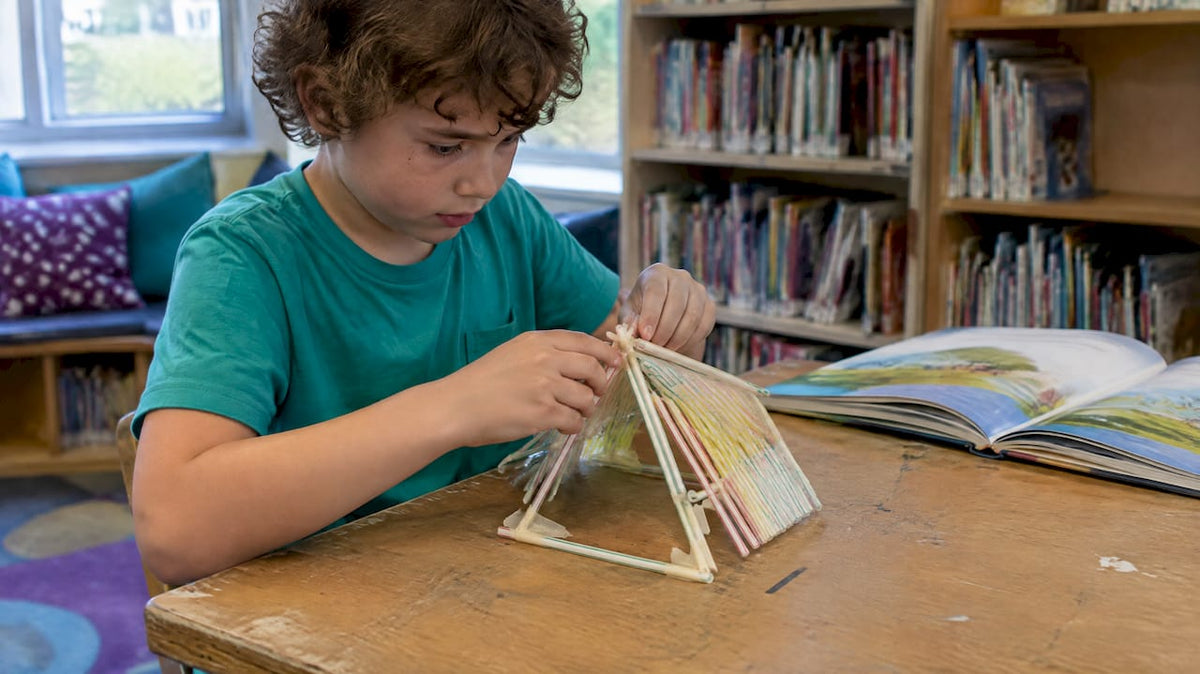
An Indiana University journal article on Penny, the fourth little pig, based on a 2022 trade book by Kimberly Derting and Shelli Johannes, shows how a familiar tale becomes a building challenge. The authors rely on the Engineering Design Process: Ask, Imagine, Plan, Create, Test and Improve. They also recommend a design brief, a short narrative that sets the constraints and criteria for the build.

You can write one in two minutes: “The wolf is coming and the pig has only 20 straws, one roll of tape and a sheet of paper. Build a shelter that holds up a small book.” A brief like this keeps the activity focused and lets children practice something close to how professional engineers work. Children can sketch the blueprint, build, test with a fan or a hair dryer on low, and then revise.
A cultural story and a book the child makes
NASA Science’s Northern Lights Storybook is a free K-5 activity in which students read cultural aurora stories and then create custom books. It is a good reminder that the companion does not have to be an experiment alone. After reading the stories, a child can write and illustrate their own explanation of what causes the lights, then compare it with the science.
Match the companion to the age
| Age | Book type | Companion activity | What to record |
|---|---|---|---|
| 5 to 6 | Picture book, wordless or read aloud | One-step investigation: float or sink, melt or stay frozen | Drawings, one dictated sentence |
| 7 to 8 | Illustrated narrative or simple nonfiction | Build-and-test challenge with a design brief | Simple table, labeled sketch |
| 9 to 10 | Short chapter book or science storybook | Fair test with one changed variable | Measurements, a prediction, a conclusion |
| 11 to 13 | Nonfiction, biography, longer fiction | Multi-trial investigation, student-written design brief | Graph, written explanation citing the data |
These ranges are a starting point, not a rule. A confident eight-year-old may enjoy a fair test, and a thirteen-year-old who dislikes writing may do their best thinking with a labeled diagram.
Making companion work welcoming for kids who struggle
Some children avoid science time because it comes with a lot of reading and writing. That is where companion activities can either help or hurt, and the difference lies in how you set them up.
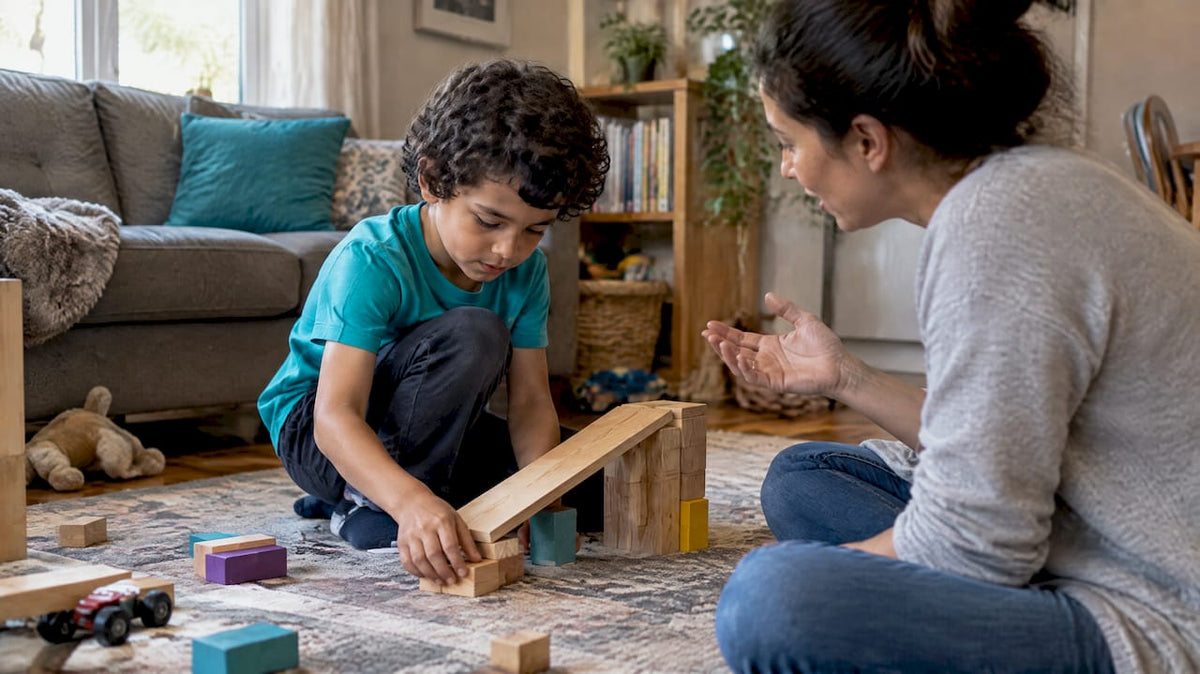
Separate the prototype from the person. Educators writing in the Indiana University journal advise defining the difference between a mistake (rushing, not following directions) and a failure (a prototype that does not meet the criteria). Without that distinction, students can label themselves as “bad” at science. They suggest teaching synonyms for “fail” and treating failed tests as a routine, valuable outcome, and they steer away from slogans such as “failure is not an option.” Say instead: “The bridge told us something. What did it tell us?”
Give the writing a lighter job. Let the child draw, label, dictate or build a chart before writing a sentence. Reflection can start as a spoken answer to three prompts: “What did you try? What happened? What would you change?”
Use visuals as a way in. Wordless books, diagrams and photographs let a child show understanding without decoding text first.
Keep the stakes low and the success visible. A short activity that ends with a working result, or a clearly useful result, builds the belief that “I can do this.”
Take the book outside
Companion work does not need a table. A nature story invites a walk, and a walk is a good place to practice observing, describing and recording. If you want ideas for putting those literacy skills to work in the yard or park, these outdoor science activities for kids give simple starting points. Bring a clipboard, ask the child to write or sketch three observations, and compare them back at home with what the book said.
Our perspective: identity first, then experiments
We built Team Genius Squad around a real family journey with dyslexia and dysgraphia, and it taught us that the most important ingredient in a book companion is not the experiment. It is who the child believes they are while they do it.
When a child puts on a lab coat, wears a badge and is handed a real question, something shifts. They stop being a student who is being tested and become a scientist who is investigating. That is the idea at the heart of our E³ Method: Engage the child’s curiosity, Encourage them through each attempt, and Empower them to see themselves as an innovator.

This is why we weave experiments together with reading, writing and reflection instead of treating them as separate subjects. A child who struggles to write a paragraph in a language arts block will often fill a page with observations when the data is a fizzing, color-changing result they made themselves. The experiment gives the writing a purpose. And we keep the work screen-free, because tactile discovery gives every kind of mind a way in.
If you remember one thing from this guide, let it be this: celebrate the attempt, name what the test taught you, and let the child tell the story of their discovery in their own way. Different minds can build the future, and a good book plus a good question is a fine place to start.
— Tita
Where our kits and books fit
If you would rather not gather materials and design every activity yourself, our experiment kits are made for this kind of work. They are hands-on and screen-free, and they connect experiments with reading, writing and reflection for children ages 5 to 13. For example, the Shocking Electric Science kit lets a child explore electricity, and the STEM-STEAM Electricity Lab Experience Bundle extends it. To pair a story with the hands-on work, browse our STEM-STEAM books and puzzles or the STEM Book Bundle.
For a live experience, you can book a 30-minute one-on-one Zoom experiment with Ava, our STEM Ambassador, for $50, or ask about her group sessions on our shop page. Educators can also look at our lesson plans.
Build your own companion in 20 minutes
Use this checklist the next time a book catches a child’s interest.
- Pick the question. Read the book and ask the child what they still wonder about. Choose one question you can test with household items.
- Write a two-sentence design brief. Include the goal, the limits (materials, time) and how you will know it worked.
- Prepare a one-page record sheet. Add a box for a prediction, a box for a drawing, a table for results and one line for “What I would change.”
- Run the test twice. The second run is where improvement happens. Ask what changed and why.
- Link back to the book. Ask: “Did the book get it right? What would you add to the story now?”
- Let them share. A child can teach a sibling, a grandparent or a class. Explaining is the final step in learning.
For more ready-made ideas, see our guides to 15-minute maker challenges for STEM picture books, low-prep science experiments by grade and STEM storytelling examples. Teachers who want to connect activities to standards may like our post on NGSS STEM activities you can run this week, and our overview of literacy-first, neurodivergent-friendly hands-on STEM explains the approach in more depth.
What to avoid
- Turning the activity into a quiz. If the child feels tested on the book, the curiosity drains out. Ask open questions.
- Over-scripting. A step-by-step recipe produces a result but not thinking. Leave room for the child to choose a variable.
- Skipping the reflection. The experiment is half the learning. Talking or writing about it is the other half.
- Treating a surprise as a mistake. An unexpected result is data. Ask what could explain it, then test that.
- Doing too much at once. One book, one question, one activity is a complete lesson.
Frequently asked questions
What are science book companion activities?
They are hands-on investigations, data sheets and reflection prompts that go with a science book or a picture book. The child reads, tests an idea the book raises, records what happens and talks or writes about it. The book becomes the springboard rather than the whole lesson.
Do picture books work for older kids?
Yes. Educators at Northern Illinois University point out that picture books can spark curiosity in older elementary students when paired with meaningful hands-on work. Wordless picture books are especially useful because they build the skill of reading visual information, which prepares children to analyze graphs and real data.
How do I keep reading from taking over the science?
Use reading skills inside the investigation. Have the child summarize the experiment, infer why something happened and analyze their own measurements. Keep the book portion short, and make sure most of the time goes to testing and recording.
How should I handle a failed experiment?
Treat it as information about the design, not about the child. Ask what the test showed and what to change, then try again. Naming the result as a normal part of engineering helps children keep their confidence, especially children who already find school tasks discouraging.
Sources
- PictureSTEM, INSPIRE Research Institute for Pre-College Engineering
- Integrating science content with literacy in the elementary classroom
- A Content Analysis of Scientific Practices in a Fourth-Grade Commercial Program, BYU
- Engineering a Fairy Tale: STEM Learning with Penny, the Fourth Little Pig
- Snowman science investigations, NIU STEAM
- Northern Lights Storybook, NASA Science
- HSEO Grade 3-5 Teacher’s Guide

Leave a comment
This site is protected by hCaptcha and the hCaptcha Privacy Policy and Terms of Service apply.