Maker Mindset for Parents: A Practical Guide
The maker mindset is a can-do, growth-oriented approach where children learn by doing, iterating, and treating failure as useful data — grounded in constructivist learning and closely aligned with Carol Dweck’s growth mindset research. Teamgeniussquad’s proprietary E³ Method (Engage, Encourage, Empower) puts this into practice through hands-on, screen-free STEAM kits designed for young children. Start today: run a short experiment session and end it with one question — “What would you try differently next time?”
Table of Contents
- What is the maker mindset, and why does it matter for your child?
- What does a maker mindset actually look like in a child?
- How can parents and educators actively support the maker mindset?
- What features should you look for in hands-on STEAM kits?
- How do you make maker activities work for neurodivergent children?
- How do you know if a child’s maker mindset is growing?
- A 4-week starter plan you can run at home or in the classroom
- The E³ Method and the thinking behind this guide
- Key Takeaways
- What this work means to us
- Teamgeniussquad kits that put this into practice
- Useful sources and further reading
What is the maker mindset, and why does it matter for your child?
Children who develop a maker mindset build creative confidence, grit, and academic engagement by turning abstract ideas into things they can touch, test, and improve. The benefits show up quickly: kids who make things regularly tend to persist longer on hard problems, communicate their thinking more clearly, and feel genuinely capable rather than just told they are.
Ages 8–11 represent a particularly important window. Research shows that during this developmental stage, supporting a maker identity matters as much as teaching any specific technical skill. A child who decides “I am someone who builds things” at age nine carries that belief into middle school, high school, and beyond.
The social dimension matters too. Making alongside peers — sharing ideas, borrowing solutions, celebrating each other’s prototypes — builds collaboration skills that no worksheet can replicate. Hands-on STEAM benefits extend well past science class.
- Creative confidence: Children learn that their ideas are worth trying, even before they know if they will work.
- Grit and persistence: Hitting a wall becomes a prompt to iterate, not a reason to quit.
- Concrete understanding: Abstract concepts like buoyancy or circuits click when kids build with them.
- Collaboration: Sharing a build table teaches negotiation, listening, and generosity with ideas.
- Identity formation: “I am a maker” is a self-concept that reshapes how a child approaches every new challenge.
Research spotlight: For children ages 8–11, fostering a maker identity is as developmentally significant as teaching technical skills — the self-concept formed in this window shapes long-term learning behavior.
What does a maker mindset actually look like in a child?
Six behaviors signal that a child is genuinely developing this mindset, and each one is worth naming out loud when you see it.
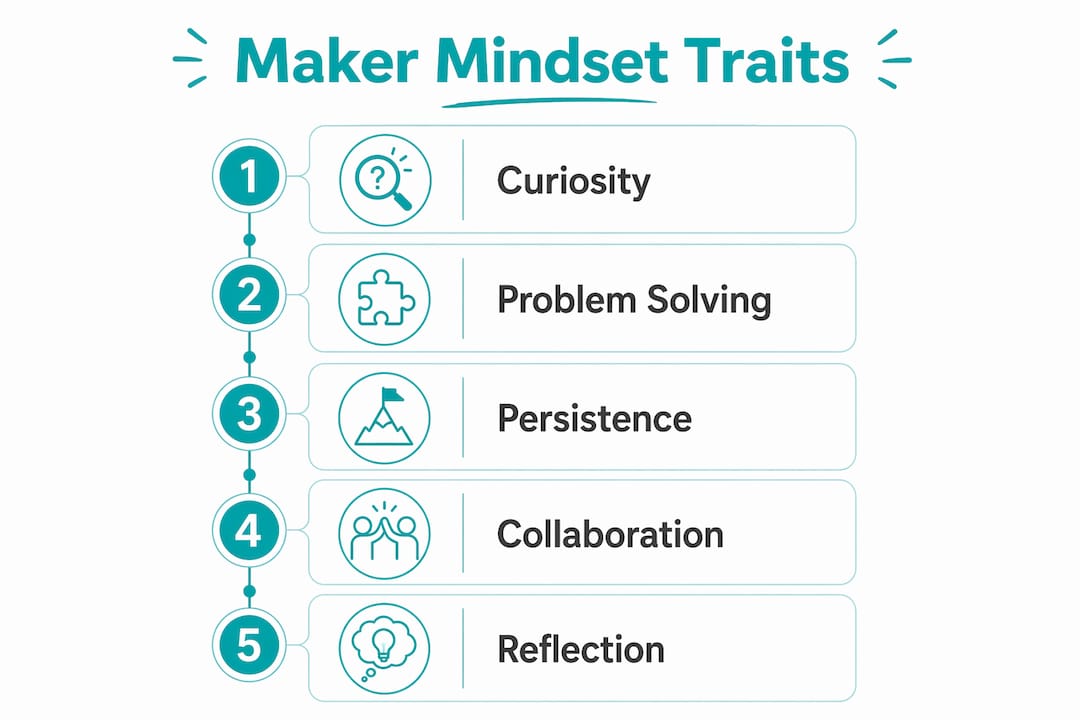
Experimentation looks like a seven-year-old who pours vinegar into baking soda just to see what happens — twice, then a third time with more vinegar. Iteration is the ten-year-old who rebuilds her cardboard bridge after it collapses, this time with a different arch. Tolerating failure shows up when a child says “that didn’t work” without shutting down. Curiosity drives the questions that come before any building starts. Collaboration means a child who asks a sibling for ideas instead of guarding the project. Playful design thinking is the willingness to make something silly on purpose, just to see if silly works.
Identity language ties all six together. When a child says “I try again” instead of “I can’t do this,” that shift is the maker mindset in action. The maker movement has always emphasized community and open sharing — and children who see themselves as part of that community feel less alone when they get stuck.
“Shifting language from ‘You’re so smart’ to ‘You worked hard and tried new strategies’ is one of the most powerful things an adult can do to build a maker identity in a child.” — aligned with Carol Dweck’s growth mindset research
How can parents and educators actively support the maker mindset?
The single most effective adult behavior is to engage with the process, not fix the product. When a child’s tower falls, your job is curiosity, not rescue.
Language that builds makers:
- Instead of “Good job!” try “Tell me what you were thinking when you built that part.”
- Instead of “That’s wrong” try “Interesting — what do you think happened?”
- Instead of “Let me show you” try “What’s one thing you could change and test?”
- Instead of “You’re so creative” try “You kept trying even when it got hard.”
A 30–45 minute session template (adapted from the design thinking framework):
- Empathize (5 min): Pose a real problem. “How could we build something that holds 10 pennies?”
- Brainstorm (5 min): Sketch or talk through ideas — no wrong answers.
- Prototype (15 min): Build with whatever is on hand.
- Test (5 min): Try it. Does it work? What broke?
- Reflect (10 min): Draw or write one thing that went wrong and one thing to try next time.
Age scaffolding: children ages 5–7 benefit from a pre-set materials tray and a single clear challenge. Ages 8–11 can define their own problem. Ages 12–13 can run the full cycle independently and document their process in a maker journal.
Pro Tip: The reflection step is where the real growth happens. For neurodivergent children especially, documenting frustrations and fixes — even as a drawing — builds emotional regulation alongside maker identity. Never skip it.
What features should you look for in hands-on STEAM kits?
Not every kit builds a maker mindset. The features below are what actually move the needle.
- Low-floor, high-ceiling design: The activity is accessible to a beginner but open enough for an advanced child to go further. Simple tactile materials are enough — expensive tech is not required.
- Clear iteration cycles: The kit should invite a second try, not just a single correct outcome.
- Sensory-friendly materials: Non-toxic, varied textures, and no overwhelming smells or sounds.
- Role-play identity tools: Lab coats, badges, and certificates help children step into the identity of a scientist or inventor, not just complete a task.
- Literacy integration: Reading a challenge card, writing a hypothesis, and reflecting in a journal connect STEAM to language skills.
- Reflection prompts: Built-in questions like “What surprised you?” anchor the experience in growth.
By age band: Ages 5–7 need highly guided, sensory-rich activities with large components (no choking hazards — always check for parts smaller than 1.75 inches for children under 6). Ages 8–11 can handle multi-step builds with some ambiguity. Ages 12–13 are ready for open-ended challenges with minimal scaffolding and adult supervision for any electrical or heat-based components. Always read kit age ratings and supervise experiments involving liquids, heat, or small parts.
Screen-free kits remove the passive-consumption default and put creative agency back in a child’s hands.
How do you make maker activities work for neurodivergent children?
Tactile, screen-free making reduces the binary “right/wrong” pressure that often triggers anxiety in neurodivergent learners. Embodied cognition research shows that physically manipulating materials creates deeper understanding than watching or listening — a genuine advantage for children with dyslexia, dysgraphia, ADHD, or sensory processing differences.
Practical adaptations:
- Sensory swaps: Offer textured grips on tools, swap glitter glue for plain glue if sensory overload is a concern, and provide noise-canceling options for louder experiments.
- Predictable routines: Use a visual schedule showing each session phase so children know what comes next.
- Alternate communication: Accept drawings, verbal explanations, or voice memos in place of written reflections.
- Simplified steps: Break multi-step instructions into single-action cards with pictures.
- Choice within structure: Offer two material options rather than an open-ended “use anything” prompt, which can feel paralyzing.
Two concrete examples: a child with dysgraphia can photograph each build stage instead of writing notes — the photo log becomes a process portfolio that is just as meaningful. A child with sensory sensitivities can use foam pieces instead of sharp-edged cardboard, keeping the creative challenge identical while removing a physical barrier. Neurodivergent-friendly STEAM approaches consistently show that access to the activity, not simplification of the challenge, is the key.
| Adaptation | Why it helps |
|---|---|
| Visual schedule for session phases | Reduces transition anxiety and supports executive function |
| Photo log instead of written journal | Removes writing barrier while preserving reflection |
| Two-choice material selection | Maintains agency without overwhelming open-endedness |
| Textured tool grips | Supports fine motor differences and sensory regulation |
| Single-action instruction cards | Reduces working memory load during multi-step builds |
How do you know if a child’s maker mindset is growing?
Progress shows up as greater persistence, language that signals maker identity (“I want to try it again”), and a growing willingness to share work and invite feedback. You do not need a formal assessment — you need a simple log.
Copy this table into a notebook or a shared document and fill it in after each session. Over four to six weeks, patterns emerge: a child who rated confidence at 2 in week one and 4 in week four has measurable growth, even if no single project was “perfect.”
A portfolio of photos, drawings, and reflection notes tells a richer story than any grade. If a child consistently refuses to try, shuts down at the first obstacle, or expresses strong shame around mistakes after several weeks of supported making, that is worth a conversation with a school counselor or learning specialist.
A 4-week starter plan you can run at home or in the classroom
The goal: build one maker habit per week, moving from pure curiosity to confident sharing. Each session runs 30–45 minutes.
| Week | Focus | Session activity | Ages 5–7 mod | Ages 8–11 mod | Ages 12–13 mod |
|---|---|---|---|---|---|
| 1 | Explore and wonder | Sensory material free-play: touch, sort, describe | Pre-sorted tray, one question prompt | Child chooses materials and poses own question | Child designs the question and predicts outcomes |
| 2 | Build and prototype | Build something that solves a simple challenge | Adult sets challenge, child builds | Child defines challenge and builds | Child sets challenge, builds, and documents |
| 3 | Iterate and test | Rebuild after first attempt fails | Adult guides second try with one change | Child identifies what to change independently | Child runs multiple iterations and tracks results |
| 4 | Reflect and share | Present build to family or class, explain process | Draw and narrate | Write or record a short explanation | Teach a younger child or peer how to do it |
Low-cost materials shopping list:
- Cardboard tubes, egg cartons, and cereal boxes (free from recycling)
- Craft sticks, rubber bands, and binder clips (under $5 at any dollar store)
- Non-toxic white glue and tape
- Aluminum foil and wax paper
- Dried pasta and toothpicks for structural challenges
Safety reminder: Always check for small parts with children under 6. Supervise any activity involving water, heat, or electrical components. Use non-toxic, age-rated materials throughout. For hands-on STEAM activities with younger children, keep sessions short and materials simple.
The E³ Method and the thinking behind this guide
The E³ Method works because it matches how children actually build confidence: through engagement that feels safe, encouragement that is specific and process-focused, and empowerment that comes from genuine success. Teamgeniussquad developed this framework from a real family experience with dyslexia and dysgraphia, and it maps directly to every practice in this article.
- Engage: Draw children into a challenge that feels exciting, not intimidating.
- Encourage: Respond to effort and strategy, not just outcomes.
- Empower: Give children the tools, language, and identity to call themselves makers.
This guide draws on maker education research published in Frontiers in Education, practitioner guidance from Edutopia, and the developmental research on identity formation in elementary-aged children. It is written as general educational guidance; for children with significant learning differences, consult a qualified learning specialist for individualized support.
Key Takeaways
The maker mindset grows through consistent, low-stakes experimentation paired with identity-affirming language and structured reflection — not through expensive tools or perfect outcomes.
| Point | Details |
|---|---|
| Definition | The maker mindset is a can-do, iterative approach rooted in constructivist learning and growth mindset research. |
| Critical age window | Ages 8–11 are especially important for forming a maker identity that shapes long-term learning behavior. |
| Most effective adult move | Engage with the process, not the product — ask “What would you try next?” instead of fixing the build. |
| Neurodivergent access | Tactile, screen-free activities reduce right/wrong pressure and support embodied learning for diverse learners. |
| Teamgeniussquad | Teamgeniussquad’s E³ Method kits are built around identity-driven, screen-free STEAM for ages 5–13. |
What this work means to us
When Ava N. Simmons first stepped into the role of a young innovator, she showed us something we had not seen clearly before: that a child who struggles in a traditional classroom can absolutely thrive when the learning meets them where they are. That insight is the reason every Teamgeniussquad kit is built the way it is. We hope this guide gives you language, routines, and confidence to celebrate the maker in your child, whatever their learning style. If your child builds something this week, we would love to see it — share your photos and reflections with your school community or tag us online. Different minds build the future, and yours is one of them.
Teamgeniussquad kits that put this into practice
Children who have the right materials in front of them move through the maker cycle faster and with more confidence. Teamgeniussquad’s experiment kits are designed around every feature this article recommends: low-floor/high-ceiling challenges, built-in reflection prompts, role-play identity tools like lab coats and certificates, and screen-free, sensory-friendly materials for ages 5–13.
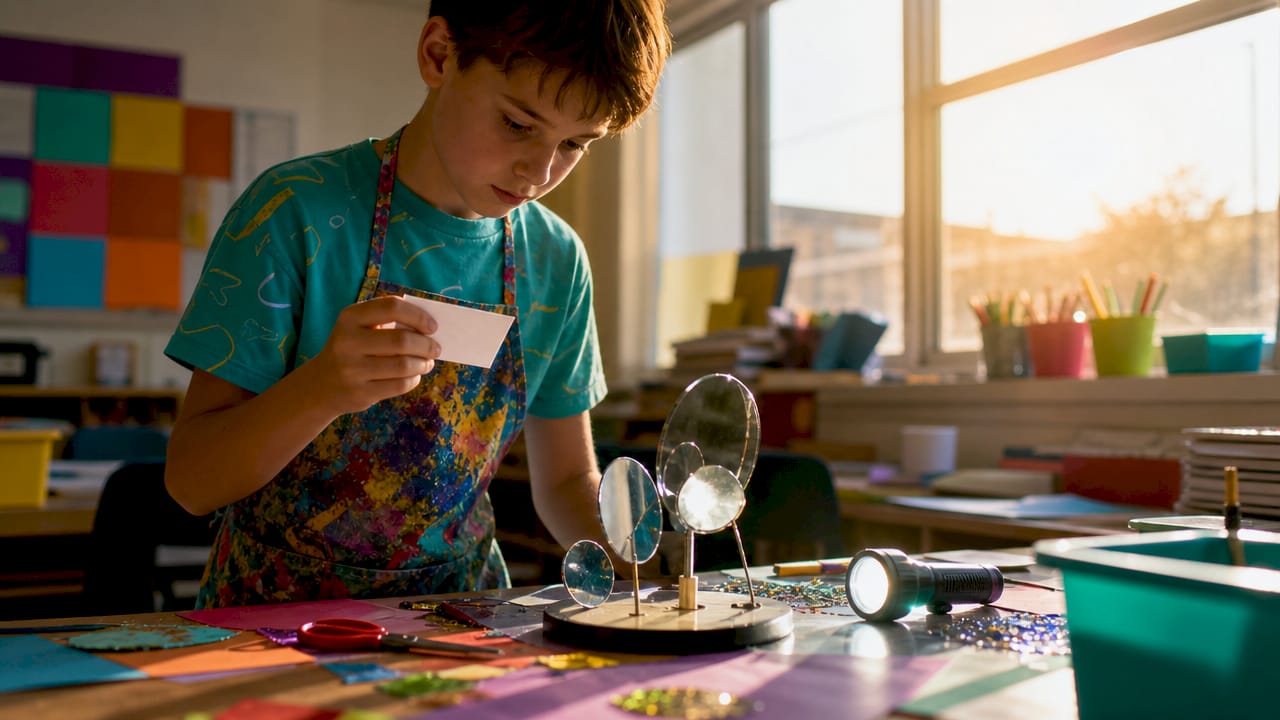
For ages 5–8, the Slime, Gel, and Goop kit offers a sensory-rich first maker experience. Ages 8–13 can step into the Solar Energy Kit, which builds iteration skills through real prototyping with mirror disks and solar panels. Every kit is powered by the E³ Method and grounded in the same neurodivergent-inspired design philosophy behind this guide. Browse the full collection and find the right starting point for your child.
Useful sources and further reading
- The Maker Mindset — foundational chapter on the maker movement’s values, community structure, and educational implications.
- Frontiers in Education: Maker Mindset Research — peer-reviewed study on how design thinking and maker pedagogy shape mindset formation and transformation.
- Edutopia: Crafting the Maker Mindset — practitioner guide on documenting process, embodied cognition, and reflection strategies for diverse learners.
- Making the Maker (ScienceDirect) — research on identity formation in elementary-aged children and the developmental importance of ages 8–11.
- Benefits of Being a Maker — accessible overview of creative confidence, grit, and academic benefits of maker experiences.
- StemMinds: What Is a Maker Mindset? — community-focused explanation of collaboration, open sharing, and maker culture values.
- Carol Dweck Growth Mindset / Maker Mindset alignment — summary connecting Dweck’s language-shift research to maker identity development.
- AI-powered toys and low-screen learning — industry context on tactile, low-screen approaches to children’s learning and toy design.


Leave a comment
This site is protected by hCaptcha and the hCaptcha Privacy Policy and Terms of Service apply.