What Is Immersive Learning? A Guide for Educators
Immersive learning is defined as a pedagogical approach where learners actively participate in deliberately designed experiences that integrate cognitive, affective, and psychomotor domains, engaging thinking, feeling, and doing simultaneously. Unlike passive instruction, immersive learning places children inside the experience rather than in front of it. Grounded in experiential learning theory and constructivism, it is not a technology category but a theoretical lens for designing authentic, active engagement. Research synthesizing over 1,400 publications confirms that immersive learning improves engagement, comprehension, and motivation, particularly in STEM and healthcare education. For educators, parents, and counselors, understanding what immersive learning is opens the door to profoundly different outcomes for children.
What is immersive learning built on? Core components and psychology
Immersive learning works because it targets how children actually build understanding. The three domains it integrates, cognitive (thinking), affective (feeling), and psychomotor (doing), are rarely addressed together in traditional classroom instruction. When all three activate at once, children retain more and connect learning to real life.

The central psychological concept is presence: the feeling of being inside the learning experience rather than observing it. Presence is achieved through authentic tasks that require active decision-making, collaboration, and problem-solving. Better graphics or more expensive hardware do not create presence. A child who must decide how to build a bridge from craft sticks experiences more presence than one watching a 3D simulation of bridge construction.
Four components define effective immersive learning environments:
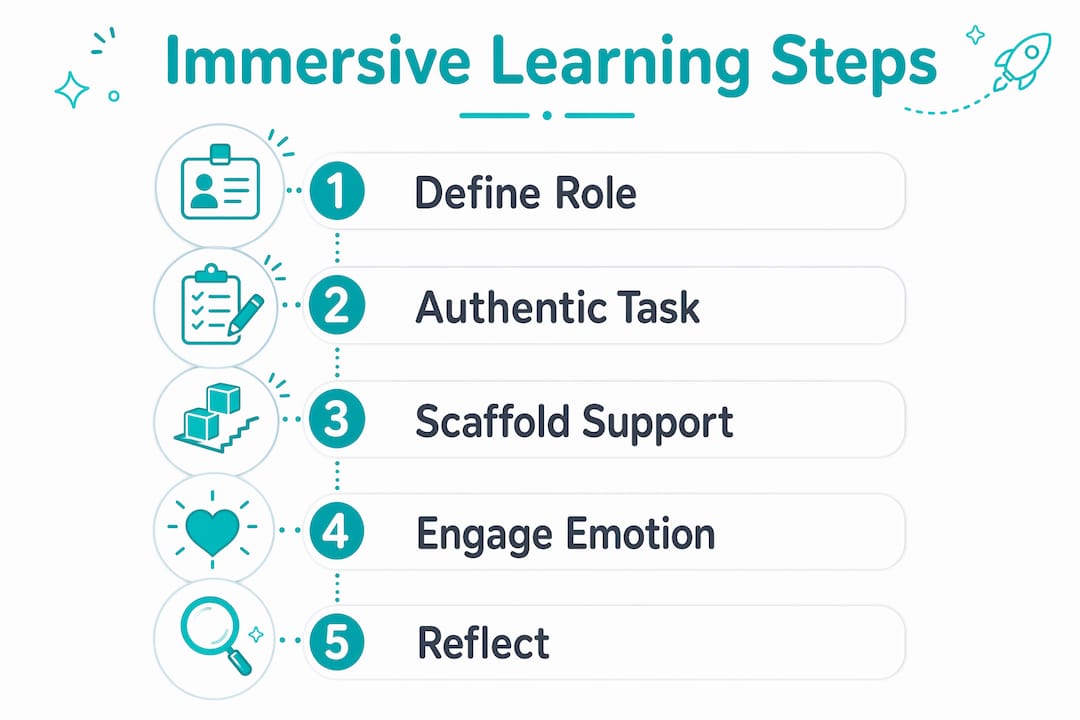
- Defined learner roles. Assigning specific roles shifts children from passive observers to active participants. A child who is “the lead scientist” behaves differently than one who is “a student doing an experiment.”
- Scaffolding. Structured guidance prevents learners from becoming overwhelmed or disengaged. Scaffolding manages cognitive load and keeps children progressing at the right pace.
- Active tasks. Children must make real decisions and face real consequences within the experience, not just follow a script.
- Authentic context. The scenario must feel real enough to matter. Role-play in a mock science lab carries more weight than a worksheet about science.
These components interact. A well-defined role without scaffolding leads to confusion. Scaffolding without authentic context produces compliance, not engagement. The design must hold all four in balance.
Pro Tip: When designing an immersive activity for children, write the learner’s role as a job title first. “Junior Geologist” or “Energy Engineer” tells a child exactly who they are in the experience before the activity even begins.
Does immersive learning require VR or AR technology?
The most persistent misconception about immersive learning is that it requires virtual reality or augmented reality hardware. Immersive learning is technology-agnostic. Effective immersive experiences can use role-play, environmental transformation, physical props, and storytelling with zero screens involved.
This matters because many educators and parents assume they need expensive equipment to deliver immersive experiences. A classroom rearranged to look like a research lab, with children wearing lab coats and working through a real experiment, meets every criterion for immersive learning. The authenticity of the task creates the experience, not the device delivering it.
Complex or excessive technology can actually reduce learning effectiveness by increasing cognitive load. When children spend mental energy navigating an unfamiliar interface, they have less capacity for the actual learning. This is called the split-attention effect, and it is a documented risk in poorly designed technology-heavy environments.
| Approach | What creates immersion | Risk if misapplied |
|---|---|---|
| High-tech (VR/AR) | Simulated environment, sensory engagement | Cognitive overload, interface distraction |
| Low-tech (role-play, props) | Authentic context, defined roles, physical tasks | Insufficient scaffolding, unclear objectives |
| Hybrid (physical kits with narrative) | Tactile engagement plus identity-driven story | Losing the narrative thread mid-activity |
The right approach depends on the learner’s age, the learning goal, and the available scaffolding. More technology is not always better. Dimensional balance aligned to educational goals is the deciding factor.
Pro Tip: Before adding any technology to an immersive activity, ask: does this tool make the task more authentic, or does it just make it more complicated? If the answer is the latter, remove it.
What are practical examples of immersive learning for children?
Children benefit from immersive learning in ways that go well beyond academic performance. Research synthesis from over 1,400 publications confirms that immersive learning improves engagement, comprehension, and motivation, with particularly strong results in STEM education. For children ages 5–13, the developmental benefits extend to confidence, identity formation, and intrinsic motivation.
Here are five concrete examples of immersive learning methods that work for children:
-
Scientist role-play with real experiments. Children put on lab coats, receive a “mission briefing,” and conduct a physical experiment with real materials. The role defines their identity; the experiment creates authentic stakes. Identity-driven STEAM activities like this enhance motivation and developmental outcomes through ownership and active learning.
-
Virtual science exploration. Virtual activities such as VR solar system tours or coding-based immersive games improve children’s access to experiences they cannot have in a classroom. These work best when paired with a follow-up physical or reflective task.
-
Environmental transformation. A living room or classroom becomes a rainforest, a space station, or a marine biology lab through props, sound, and storytelling. Children navigate the environment as characters with specific roles and goals.
-
Language immersion through cultural activities. Immersive language learning activities that embed vocabulary in cultural context produce stronger retention than rote memorization. Children learn by doing, not by drilling.
-
STEAM discovery kits with narrative. Physical kits that combine real experiments with storytelling and role-based identity tools give children a complete immersive experience without a screen. Teamgeniussquad’s E³ Method (Engage, Encourage, Empower) structures this progression deliberately, moving children from curiosity to confidence through each activity.
The common thread across all five examples is that children are not watching learning happen. They are the ones making it happen. That shift in agency is what produces the developmental gains educators and parents are looking for.
How can educators, parents, and counselors implement immersive learning?
Implementing immersive learning does not require a curriculum overhaul. It requires intentional design of three things: the learner’s role, the task’s authenticity, and the scaffolding that holds the experience together.
Effective immersive learning requires scaffolding to guide learners, maintain focus, and prevent passivity, especially in stimulating environments. Without it, even the most creative immersive setup can collapse into chaos or disengagement. Scaffolding looks like a mission card that outlines the child’s task, a checkpoint question halfway through, and a reflection prompt at the end.
Practical steps for educators, parents, and counselors:
- Define the role before the activity starts. Give the child a title, a purpose, and a clear problem to solve. “You are a water scientist. Your job is to find out which materials filter water best.” This one step changes the child’s entire orientation to the task.
- Use physical materials whenever possible. Tactile engagement deepens presence. A child who touches, builds, and tests retains more than one who watches or clicks. Hands-on STEAM activities are a direct application of this principle.
- Balance stimulation with cognitive capacity. Younger children need simpler scenarios with fewer variables. Adding complexity too quickly breaks immersion and increases frustration.
- Design for neurodiversity. Immersive learning is particularly effective for children who struggle in traditional environments. STEAM activities for neurodiverse learners show that tactile, role-based experiences reduce the barriers that written instruction creates for children with dyslexia, dysgraphia, or attention challenges.
- End with reflection. Ask children to describe what they discovered, what surprised them, and what they would do differently. Reflection converts experience into lasting understanding.
Pro Tip: For children who resist structured activities, start with the identity, not the task. Let them choose their scientist name and decorate their “lab badge” before the experiment begins. Ownership of identity creates buy-in for the work that follows.
Key Takeaways
Immersive learning produces its strongest outcomes when experiential authenticity, defined learner roles, and structured scaffolding work together, regardless of the technology involved.
| Point | Details |
|---|---|
| Definition of immersive learning | It integrates cognitive, affective, and psychomotor domains through active participation in authentic experiences. |
| Presence over technology | Psychological presence comes from authentic tasks and decision-making, not from VR hardware or screen quality. |
| Role definition drives engagement | Giving children a specific identity and purpose shifts them from passive observers to active problem-solvers. |
| Scaffolding prevents passivity | Structured guidance keeps learners focused and progressing, especially in stimulating or open-ended environments. |
| Low-tech methods are fully valid | Role-play, physical kits, and environmental transformation meet every criterion for effective immersive learning. |
What I’ve learned about immersive learning that most guides get wrong
Most conversations about immersive learning get stuck on the technology question. Educators ask whether they need a VR headset. Parents wonder if a tablet app counts. The real question is almost never asked: does the child believe they are doing something that matters?
I have seen children completely absorbed in a cardboard-box science lab, and I have seen children glaze over inside a high-end VR simulation. The difference was never the hardware. It was whether the child had a clear role, a real problem, and a reason to care about the outcome. That is the heart of immersive learning, and it is available to every educator and parent right now, with whatever materials are on hand.
The other thing most guides miss is the identity piece. Children do not just learn by doing. They learn by becoming. When a child puts on a lab coat and receives a mission, something shifts. They are not playing at science. They are being a scientist. That distinction changes what they are willing to try, how long they persist, and how they talk about the experience afterward. Teamgeniussquad was built on exactly this insight, and it is the reason the E³ Method starts with Engage before it ever gets to Empower.
— Tita
Teamgeniussquad’s hands-on kits bring immersive learning home
Knowing the principles of immersive learning is one thing. Having the right tools to put them into practice is another.

Teamgeniussquad designs hands-on, screen-free STEAM discovery kits that apply every principle covered in this article. Each kit gives children a defined scientist identity, a real experiment to conduct, and a structured narrative that carries them from curiosity to confidence. The proprietary E³ Method (Engage, Encourage, Empower) acts as built-in scaffolding, so educators and parents do not have to design the experience from scratch. Kits like the Science Solar Energy Kit and the full range of experiment kits are built for children ages 5–13, including those who learn differently. Real materials, real roles, and real results.
FAQ
What is immersive learning in simple terms?
Immersive learning is an educational approach where children actively participate in authentic, role-based experiences that engage thinking, feeling, and doing at the same time. It is defined by the quality of the experience, not the technology used to deliver it.
Does immersive learning require virtual reality?
No. Immersive learning is technology-agnostic. Effective immersive experiences use role-play, physical materials, and environmental transformation without any screens or VR hardware.
What are the main benefits of immersive learning for children?
Research confirms that immersive learning improves engagement, comprehension, and motivation. For children, it also builds confidence, identity, and intrinsic motivation, especially when activities include defined roles and authentic tasks.
How does scaffolding support immersive learning?
Scaffolding provides structured guidance that keeps learners focused and prevents passivity. Without it, even well-designed immersive environments can lead to confusion or disengagement, particularly for younger children.
Is immersive learning effective for neurodivergent children?
Yes. Immersive learning is particularly well-suited for children who struggle in traditional environments. Tactile, role-based experiences reduce the barriers that written instruction creates for children with dyslexia, dysgraphia, or attention challenges.

Leave a comment
This site is protected by hCaptcha and the hCaptcha Privacy Policy and Terms of Service apply.