
Rail fence cipher: Hands-on STEAM learning for kids
Most people picture codes as something reserved for spies, software engineers, or genius-level adults hunched over a computer screen. The truth? A child as young as five can start encoding and decoding messages using nothing more than a pencil, some paper, and a fun zigzag pattern called the rail fence cipher. This hands-on activity sits perfectly at the intersection of logic, language, and play, making it one of the most surprisingly powerful STEAM tools available to parents and educators today. No cryptography background required, just curiosity and a willingness to let kids lead the way.
Table of Contents
- What is the rail fence cipher?
- How the rail fence cipher works: Step-by-step
- Teaching tips: Making the rail fence cipher accessible for every learner
- Variations, security, and real-world insights
- Fun extensions and hands-on applications at home or school
- Our take: Why the humble rail fence cipher is a powerhouse for STEAM and confidence
- Bring hands-on STEAM cipher fun home
- Frequently asked questions
Key Takeaways
| Point | Details |
|---|---|
| Hands-on cipher for STEAM | The rail fence cipher is a fun, visual way to strengthen logic and problem-solving skills in kids. |
| Visual and accessible | It externalizes thinking with a zigzag layout, perfect for neurodivergent and visual learners. |
| Not for real security | This cipher is for puzzles and learning—not for protecting actual secrets. |
| Many creative uses | There are countless ways to adapt and expand rail fence cipher activities for home and classroom. |
What is the rail fence cipher?
The rail fence cipher is one of the oldest and most visual forms of message encoding in history. Its roots trace back centuries, appearing in military and recreational puzzles long before computers existed. The name itself comes from the image it creates: if you write your message in a zigzag pattern across several horizontal lines (called “rails”), the result looks a little like the rails of a wooden fence stretching across a field.
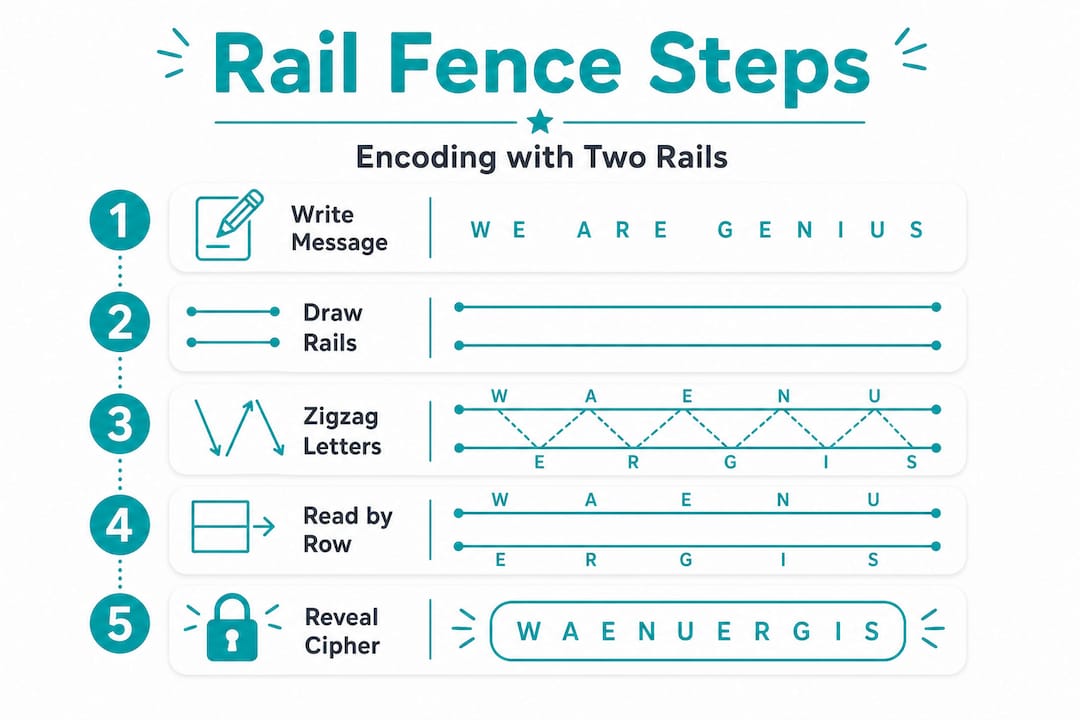
Here is how it works at its simplest. You take a message and write each letter in a diagonal, zigzag pattern across two or more imaginary “rails” or rows. Once you reach the bottom rail, you bounce back up, and once you reach the top, you bounce back down. After you’ve placed all letters, you read across each rail from left to right to get your encoded, scrambled message.
“The rail fence cipher is primarily suitable for education and puzzles rather than protecting sensitive information, making it the ideal gateway cipher for young learners.” This is exactly why it shows up so frequently in encryption puzzle activities and classroom STEAM lesson plans.
What makes it especially beloved by educators is its low barrier to entry combined with genuine cognitive engagement. You don’t need special materials or tech. A piece of paper and different colored markers are enough to bring the cipher to life visually and tactilely, which is a huge win for hands-on literacy for neurodivergent kids.
Key reasons educators reach for the rail fence cipher again and again:
- It is visual: the zigzag pattern can be seen and drawn, not just imagined.
- It is tactile: kids can write letters on strips, move them around, and reconstruct messages physically.
- It is scalable: younger children work with two rails, while older or more advanced learners tackle three, four, or more.
- It is low stakes: there is no right or wrong artistic expression, only pattern logic.
- It builds real STEAM skills: algorithmic thinking, sequencing, and pattern recognition all get a workout.
As educational suitability research confirms, the rail fence cipher is weak from a true security standpoint, but that is completely beside the point for our purposes. The point is confidence-building, curiosity-sparking, joyful discovery.
How the rail fence cipher works: Step-by-step
Once you understand what the rail fence cipher is, the next step is actually trying it. The process is easier than it looks, and watching a child’s face light up when they decode their first secret message is absolutely worth the five minutes it takes to learn.
Defining “rails”: A “rail” is simply a horizontal row in your zigzag grid. Two rails means two rows; three rails means three rows. The number of rails is the main “key” of the cipher, directly changing the zigzag shape and the resulting scrambled message. Change the number of rails, and the ciphertext changes completely.
Encoding a message: Step-by-step
- Choose your message. Start simple. Try: HELLO WORLD (remove the space for now: HELLOWORLD).
- Decide how many rails to use. Start with 2 rails.
- Write the first letter (H) on rail 1. Write the second letter (E) on rail 2. Write the third letter (L) on rail 1. Continue zigzagging until all letters are placed.
- Read across rail 1 from left to right: H, L, O, O, L
- Then read across rail 2 from left to right: E, L, W, R, D
- Combine them: HLOOLEL WRD becomes HLOOERL WD — or more precisely, the encoded message is HLOOLEL WRD.
Here is a handy reference table to see how the same message changes with different rail counts:
| Original message | 2 rails encoded | 3 rails encoded |
|---|---|---|
| HELLOWORLD | HLOOLELWRD | HOLELWRDLO |
| STEAMROCKS | SEAMOKTRCS | SRKSEMAOCT |
| ILOVESCIENCE | IOSINELVECE | ISECLVENOCI |
Notice how adding even one more rail produces a completely different output. That is the magic, and the math, of the rail fence cipher working in real time.
Decoding a message
Decoding is simply reversing the process. You figure out how many letters land on each rail (which requires a little counting and division), fill in the letters row by row, and then read the zigzag diagonally to recover the original message. This step is especially powerful for building logical reasoning because children must think backward through the algorithm.
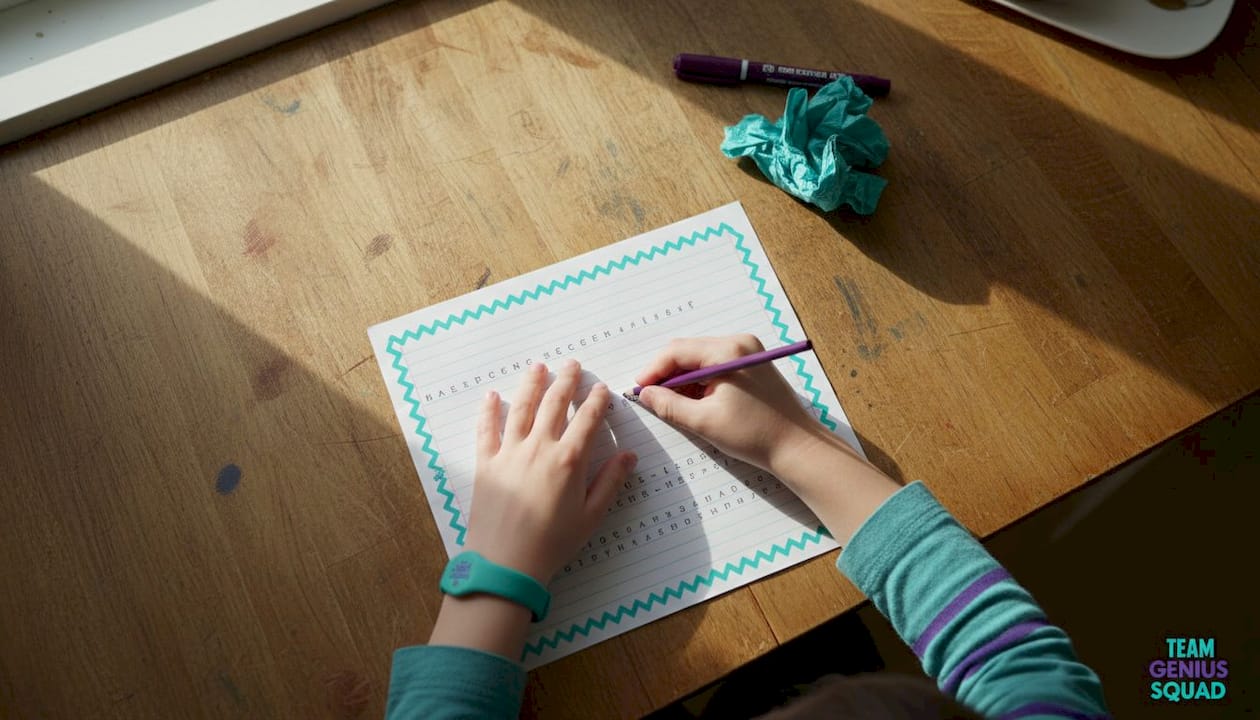
Pro Tip: Have children use two different colored markers, one for each rail, when encoding on paper. Color-coding makes the zigzag pattern instantly visible and turns decoding into a satisfying visual puzzle that clicks almost immediately for visual and tactile learners.
Encouraging kids to draw their own rail grids on graph paper before writing letters adds an extra layer of STEAM puzzle learning that connects geometry, planning, and language all in one activity. For families who want ready-to-go structures, lab kits and puzzles can provide the scaffolding that makes cipher work feel like an adventure rather than a lesson.
Teaching tips: Making the rail fence cipher accessible for every learner
Knowing how the cipher works is only half the journey. The other half is making sure every child in your home or classroom can genuinely access the activity, feel successful, and want to keep going. That is where intentional, inclusive design comes in.
Research from the Digital Technologies Hub shows that zigzag-layout ciphers are especially well-suited for children ages 5 to 13, including neurodivergent learners, because they externalize an algorithm as a visible, physical pattern that students can manipulate with their hands. Decoding becomes an act of reversing a concrete, structured pattern rather than an abstract mental gymnastics exercise.
Here are specific, practical ways to make the activity work for every type of learner:
- Use physical materials. Cut paper strips and write one letter per square. Children can physically rearrange strips into rail patterns and reconstruct messages in a hands-on, movement-friendly way.
- Bring in color. Assign a specific color to each rail. Red for rail 1, blue for rail 2. Color makes the abstract visible instantly.
- Try kinesthetic movement. Set up “rails” on the floor with tape. Children hop between rails as they “write” each letter of a message out loud or on cards. This gets bodies moving and brains engaged simultaneously.
- Scaffold for emerging readers and writers. For younger or struggling learners, pre-write the zigzag grid and ask children to simply place letter cards. Reducing the writing demand focuses energy on the logic itself.
- Extend for advanced learners. Challenge them to write messages in three or four rails, decode a message without being told the rail count, or create a cipher challenge for a sibling or classmate.
Pro Tip: Ask children to encode a message about something they care about, like their pet’s name, a favorite game, or a silly joke. Personal relevance is one of the strongest engagement boosters for neurodivergent learners, and it turns the cipher into a meaningful communication tool rather than just a worksheet exercise.
The social dimension matters just as much as the individual one. Collaborative STEM puzzles can pair cipher challenges with teamwork, where one child encodes and another decodes, building both skills and connection. Children who struggle in traditional reading-heavy environments often thrive when given a structured but playful task like this, where success is visible, repeatable, and genuinely exciting. Explore more hands-on cipher activities that pair naturally with this kind of learning.
Variations, security, and real-world insights
Once kids are comfortable with the standard two-rail or three-rail cipher, there is a whole world of variations to explore. Understanding the differences also helps parents and educators set accurate expectations about what the rail fence cipher can and cannot do.
Rail count as the adjustable key: In the standard cipher, the only variable is how many rails you use. More rails means a more complex zigzag, a longer path to decode, and a bigger challenge. For classroom use, this is a built-in differentiation tool. One activity, multiple levels.
The redefence variant: More advanced learners can explore a version called the redefence cipher, which adds an extra step: instead of always reading rails in top-to-bottom order, you permute (rearrange) the order in which rails are read. This keyed permutation increases unpredictability significantly and introduces a taste of real modern cryptographic concepts like key space.
| Feature | Standard rail fence | Redefence variant |
|---|---|---|
| Main key | Number of rails | Rail count plus reading order |
| Difficulty for kids | Beginner to intermediate | Intermediate to advanced |
| Breakability | Very easy to crack | Slightly harder, still breakable |
| Best for | Ages 5 to 10 | Ages 10 to 13 and up |
Pros and cons of the rail fence cipher in education:
- Pro: Extremely visual and easy to introduce without prior experience.
- Pro: Works across a wide age and ability range.
- Pro: Builds algorithmic thinking, sequencing, and pattern recognition.
- Con: Easily breakable due to its limited key space, meaning it should never be used for real secret communication.
- Con: Can feel repetitive without creative extensions or increasing rail complexity.
The key insight for parents and educators is this: the rail fence cipher is a teaching tool, not a security tool. Treating it as such opens up enormous creative and educational potential without creating false expectations. Pair it with STEAM books and puzzles that continue building on these foundational concepts.
Fun extensions and hands-on applications at home or school
The real fun begins when children start owning the cipher activity themselves. Moving from following instructions to designing challenges for others is where deep learning, confidence, and creativity converge.
A powerful framework from educational research frames cipher learning as algorithmic mapping, where students encode sentences and then reason about patterns to decode them. That reasoning process builds computational thinking without a screen in sight.
Here are rich, low-prep ideas to extend the activity at home or in the classroom:
- Group decode races: Split children into teams. Give each team an encoded message and the same rail count. First team to correctly decode wins. The energy in the room is remarkable.
- Sibling secret message chains: One child encodes a message, passes it to a sibling, who decodes and writes a reply in cipher. This creates an ongoing secret correspondence that kids often continue for days.
- Art + cipher projects: Write a message in rail fence pattern across a large sheet of paper, then paint or decorate around the letters to create a cipher artwork. The visual and creative combination is especially appealing for kids who blend artistic and analytical interests.
- Math tie-ins: Ask older children to calculate how many possible messages could be encoded with a given rail count and message length. This connects cipher work to multiplication, division, and early combinatorics.
- Student-designed cipher challenges: Encourage children to create their own encoded messages and write simple instruction cards explaining their rail count, then swap with a classmate or family member. This extension develops communication skills, logical thinking, and pride in their work. Find ready-to-use STEAM puzzle sets that build on exactly this kind of thinking.
Our take: Why the humble rail fence cipher is a powerhouse for STEAM and confidence
Here is what conventional wisdom gets wrong: most people assume that simple activities produce simple learning. The rail fence cipher challenges that assumption completely. In our experience working with children across a wide range of learning profiles, it is often the most structured, visual, concrete activities that produce the most transformative growth, especially for kids who have been told they are not “academic” enough.
Pattern-based activities like the rail fence cipher do something that a worksheet rarely can: they give children a visible win. When a child decodes their first message, the success is undeniable and entirely their own. That moment builds something that goes far beyond cryptography knowledge. It builds the belief that I can figure things out. For neurodivergent learners especially, that belief is priceless.
We believe parents should focus on process over outcome. A child who struggles with reading but masters the visual zigzag of a three-rail cipher is developing persistence, logical sequencing, and the ability to hold a pattern in working memory, all foundational STEAM skills. The cipher is the vehicle. Confidence is the destination.
Exploring inclusive learning techniques that pair tactile, visual activities with language helps children build a strong, well-rounded learning identity. Celebrate the process. Celebrate the decoded messages, messy grids, and creative extensions. Every zigzag is a step toward a child who sees themselves as a builder, a thinker, and a future innovator.
Bring hands-on STEAM cipher fun home
Cipher activities are just one exciting doorway into a much bigger world of STEAM discovery for children. When kids experience success through hands-on, screen-free exploration, their curiosity grows and so does their confidence.

At Team Genius Squad, we design experiences that turn every child into a young innovator. Whether you are looking for a STEAM experiment lab bundle that brings real science to life, a collection of STEAM books and puzzles that deepen critical thinking, or a full library of discovery tools, you will find it all at the Team Genius Squad Store. Each kit is built to engage, encourage, and empower the young genius in your life, no prior experience needed, just a spark of curiosity.
Frequently asked questions
Is the rail fence cipher safe for real secret messages?
No, the rail fence cipher is not secure for real secret messages and is suitable for education and puzzles only, not for protecting sensitive information.
Why do educators use ciphers like the rail fence for STEAM?
Ciphers like the rail fence help students practice algorithmic mapping, building logic, pattern recognition, and computational thinking in a hands-on, engaging way.
How can I make cipher activities more accessible for neurodivergent kids?
Use physical or visual aids like color-coded strips and tactile materials, and allow children to work collaboratively or at their own pace, since hands-on manipulation of the zigzag layout makes the algorithm concrete and approachable.
What is the most important “key” in the rail fence cipher?
The number of rails is the main key, because changing it alters the zigzag shape and produces a completely different encoded message.


Leave a comment
This site is protected by hCaptcha and the hCaptcha Privacy Policy and Terms of Service apply.