

Play Tunnels for Kids Ages 5–13: A Parent's Guide
Play tunnels are freestanding, flexible tube structures that children crawl, roll, and navigate through during active play. They build gross motor skills, sensory confidence, and social cooperation in children ages 5–13. Unlike toddler-only toys, the best play tunnels grow with children through modular configurations that support imaginative role play, obstacle courses, and cooperative storytelling. Crawling through tunnels fosters motor development, sensory organization, and balance confidence, making them one of the most developmentally rich pieces of tunnel play equipment available for this age group.
What types of play tunnels work best for children ages 5–13?
Not all kids tunnel toys are built the same, and size matters more than most parents expect. Standard single tunnels measure approximately 18 inches in diameter and range from 4 to 5.5 feet in length. Multi-piece adventure sets can exceed 9 feet total, giving older children real room to move. Toddler-sized tunnels feel cramped for kids over age 6, which is why sizing up matters early.
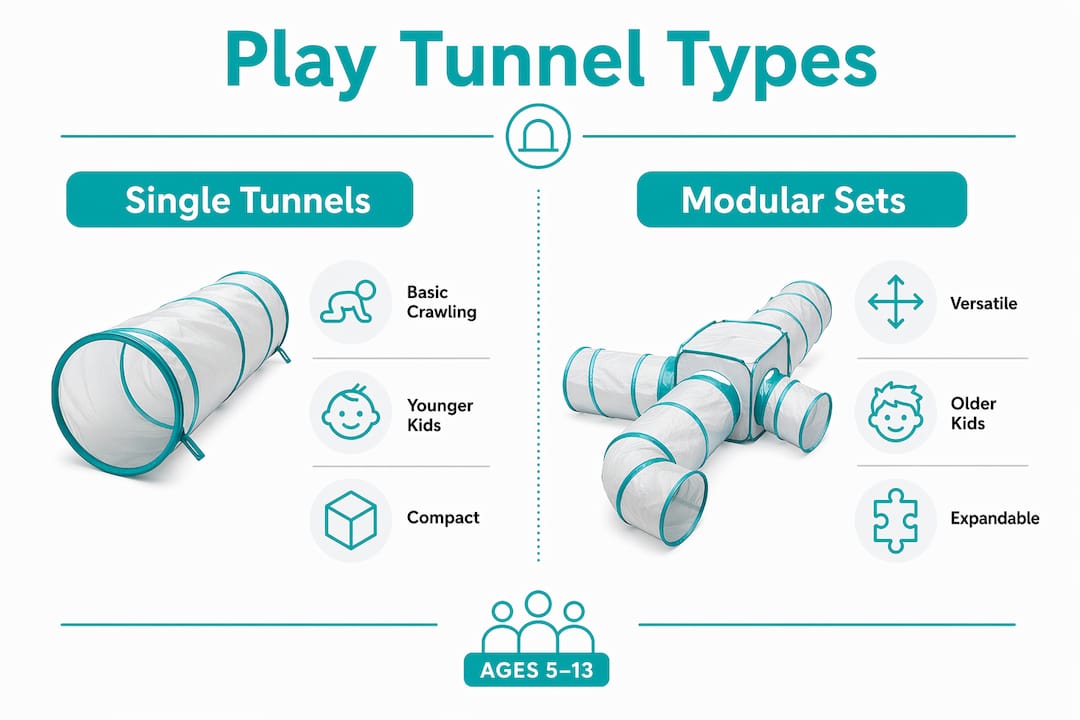
Single tunnels vs. modular sets
Single tunnels work well for younger children in the 5–7 age range who are building basic crawling confidence. For ages 8–13, modular tunnel sets with touch-and-close fastenings offer scalable play spaces that adapt to room size and social play needs. X-shaped and T-junction connectors let children build branching paths, turning a simple crawl into a full adventure map. These configurations are where cooperative play really takes off.

Indoor vs. outdoor play tunnels
Indoor play tunnels typically use lightweight polyester fabric over wire or fiberglass frames. Outdoor play tunnels need heavier fabric and UV-resistant coatings to handle sun and moisture. Quality pop-up tunnels range from $20 to $150 depending on components and materials, and many include a carry bag for easy storage. Warranties vary widely, so look for products offering at least one year of coverage.
- Single pop-up tunnels: Best for ages 5–7, easy setup, compact storage
- Multi-piece adventure sets: Best for ages 7–13, support group play and obstacle courses
- Modular connector systems: Best for classrooms or large play spaces, fully reconfigurable
- Play tents and tunnels combined: Create immersive play kingdoms with entry and exit points
Pro Tip: When buying for a classroom, choose a modular set with Velcro-style connectors. You can reconfigure the layout weekly to keep children engaged and challenged.
How to set up and safely use play tunnels at home or school
Safe setup starts before the tunnel comes out of its bag. A clear, flat surface free of sharp objects protects both the tunnel fabric and the children using it. Sharp stones or debris can puncture fabric and create holes that weaken the structure over time. For indoor use, push furniture back at least two feet on each side of the tunnel’s path.
Step-by-step setup for pop-up tunnels
- Clear the play area of toys, furniture edges, and any sharp objects on the floor.
- Remove the tunnel from its carry bag and hold it flat by the edges.
- Release the tunnel gently. Pop-up frames expand automatically. Never force them open.
- For multi-piece sets, connect sections using the Velcro or snap fastenings before releasing the frames.
- Check that all connection points are secure before children enter.
- For outdoor use, anchor lightweight tunnels with tent stakes or place weighted objects at the ends.
Folding and storing pop-up tunnels
Folding is where most parents run into trouble. Proper folding technique involves pressing both ends together flat, then twisting the tunnel in an S or figure-eight shape until it collapses into a compact circle. Misfolding snaps internal wire frames. Once broken, wire frames cannot be repaired safely. Practice the fold a few times before your first use so it becomes second nature.
Safety note: Always inspect the tunnel frame before each use. A bent or protruding wire can scratch children. If a frame wire is exposed, retire the tunnel immediately.
Pro Tip: Watch a short folding tutorial video the first time you store a new pop-up tunnel. The S-fold technique feels counterintuitive but takes less than 30 seconds once you have practiced it twice.
Prolonged sun and moisture exposure degrades both the fabric and the frame of outdoor tunnels. Store tunnels indoors or in a dry shed after outdoor use. Wipe fabric surfaces with a damp cloth and mild soap, then air dry completely before storage to prevent mold.
Creative ways to use play tunnels for physical, imaginative, and social play
Play tunnels are connectors within larger play structures, not standalone toys. Multi-piece tunnel sets help children transition from physical activity to cooperative role play, enabling storytelling and social interaction that is vital for the 5–13 age group. The tunnel becomes a secret passage, a submarine corridor, or a mission checkpoint. That shift from physical to imaginative is where the real developmental value lives.
Physical activity and obstacle courses
- Set up a timed obstacle course using the tunnel as one station among jumping, balancing, and crawling challenges.
- Add a ball pit at one end of the tunnel to build anticipation and reward movement.
- Use two tunnels in parallel for side-by-side racing, which builds healthy competition and coordination.
- Combine playground tunnels with climbing frames outdoors for a full gross motor workout.
Play tunnels support sensory integration by helping develop muscle strength and spatial awareness. That makes them especially useful for children who benefit from proprioceptive input, meaning physical feedback from their own body movements. For children with sensory processing differences, the enclosed space of a tunnel provides calming, predictable physical input.
Imaginative and social play ideas
- Mission play: Assign each child a role (navigator, engineer, scout) and create a story where the tunnel is a critical path to complete a mission.
- Play kingdoms: Connect tunnels to play tents and cube structures to build a full map with rooms, passages, and destinations.
- Storytelling relay: Each child crawls through and adds one sentence to a group story when they emerge on the other side.
- Sensory exploration: Dim the lights and place textured mats inside the tunnel for a calming sensory experience.
For educators, pairing tunnel play with creative activities for kids before or after physical sessions helps children channel their energy into focused creative work. The physical movement primes the brain for learning. That sequence, move first then create, is one of the most effective classroom transitions available.
Inclusive and special needs adaptations
Children with motor or sensory challenges benefit from tunnel play when the environment is adjusted thoughtfully. Wider modular tunnels give children using mobility aids more room to navigate. Softer lighting and reduced noise around the tunnel help children with sensory sensitivities feel safe. Pairing tunnel play with STEAM activities for special needs creates a full session that addresses both physical and cognitive development in one setting.
How to troubleshoot common play tunnel problems
Most tunnel problems come from three sources: improper folding, wrong sizing for the child’s age, and neglected maintenance. Catching these early saves money and keeps children safe.
Common issues and fixes:
- Tunnel feels too small: Children ages 8 and older need tunnels with at least 20 inches of interior diameter. Upgrade to a multi-segment set with larger dimensions.
- Frame wire poking through fabric: This is a sign of misfolding damage. Retire the tunnel. Exposed wire is a safety hazard.
- Tunnel collapses during play: Check that all connector fastenings are fully secured before children enter. For outdoor use, anchor the ends.
- Fabric tears at seams: Usually caused by sharp debris on the ground. Always clear the play area before setup.
- Children losing interest: Reconfigure the layout, add new props, or introduce a new game format. Modular tunnel systems extend usefulness well beyond toddler years by serving as components within evolving play systems.
Pro Tip: Rotate tunnel configurations every two to three weeks in a classroom setting. Children re-engage with familiar equipment when the layout changes, because the challenge feels new even when the toy is not.
Cleaning is simple but often skipped. Wipe fabric surfaces with a damp cloth after outdoor use. For deeper cleaning, use mild soap and warm water, then air dry fully. Never machine wash a pop-up tunnel. The heat and agitation damage both the fabric coating and the internal frame.
When to replace a tunnel: visible frame damage, persistent mold that does not clean off, or fabric tears larger than two inches are all signs that the tunnel has reached the end of its safe life. A $30 replacement is always better than a preventable injury.
Key takeaways
Play tunnels deliver the most developmental value for children ages 5–13 when they are sized correctly, set up safely, and used as connectors within larger imaginative play systems rather than as standalone toys.
| Point | Details |
|---|---|
| Size for the child’s age | Children over age 7 need tunnels with at least 20 inches of diameter and multi-segment length. |
| Master the S-fold | Pressing flat and twisting in a figure-eight prevents wire frame damage during storage. |
| Use tunnels as connectors | Linking tunnels to tents and cubes builds cooperative storytelling and social play. |
| Protect from sun and moisture | Store tunnels indoors after outdoor use to prevent fabric fading and frame warping. |
| Reconfigure regularly | Changing tunnel layouts every few weeks sustains engagement for older children. |
Why play tunnels deserve more credit than they get
I have watched parents dismiss play tunnels as toddler toys the moment their child turns six. That is the wrong call, and it costs children some of their best developmental years.
The real value of a tunnel for a 9-year-old is not the crawling. It is the moment three kids decide the tunnel is a submarine escape hatch and spend 45 minutes building a story around it. That kind of cooperative, self-directed play is exactly what children need more of, and it happens naturally when the physical environment invites it.
What I find most interesting is how tunnels work for children who struggle in traditional learning settings. The enclosed space reduces visual distraction. The physical movement calms the nervous system. By the time a child emerges from the tunnel, they are often more focused and ready to engage. Educators who pair tunnel play with structured learning activities see that effect consistently.
My honest advice: buy one size bigger than you think you need, invest in a modular set over a single tunnel, and treat the tunnel as a prop in a larger imaginative world rather than a piece of equipment to be used and stored. The children who get the most out of tunnel play are the ones whose adults give them permission to build something with it.
— Tita
What Teamgeniussquad offers to complement active play
Active play opens children’s minds. What comes next matters just as much.

Teamgeniussquad creates hands-on, screen-free STEAM discovery kits built for children ages 5–13. Each kit uses the proprietary E³ Method (Engage, Encourage, Empower) to turn curiosity into confidence. After a tunnel obstacle course or a storytelling session, children are primed for focused discovery. Teamgeniussquad’s experiment kits give that energy a purposeful direction, turning physical play into a launchpad for real scientific thinking. For parents and educators ready to build a complete play-to-learn environment, the full collection is available at the Teamgeniussquad store.
FAQ
What age are play tunnels designed for?
Play tunnels are suitable for children ages 3 and older, but multi-segment and modular tunnel sets are specifically designed to meet the physical and social play needs of children ages 5–13.
How do I fold a pop-up play tunnel without breaking it?
Press both ends of the tunnel flat together, then twist the structure in an S or figure-eight shape until it collapses into a compact circle. Forcing or bending the frame in the wrong direction snaps internal wires.
Can play tunnels be used outdoors?
Yes. Outdoor play tunnels work well on grass or flat surfaces, but clear the ground of sharp debris first and store the tunnel indoors after use to prevent sun and moisture damage.
How do play tunnels support sensory development?
Play tunnels support sensory integration by providing proprioceptive input through crawling, which builds muscle strength, spatial awareness, and motor confidence in children with or without sensory processing differences.
What is the difference between a single tunnel and a modular set?
A single tunnel is one fixed-length tube, typically 4–5.5 feet long. A modular set includes multiple sections and connector pieces that link tunnels, tents, and cubes into a reconfigurable play structure suited for group and imaginative play.



Leave a comment
This site is protected by hCaptcha and the hCaptcha Privacy Policy and Terms of Service apply.