

Why Choose Screen-Free Kits for Kids Ages 5–13
Screen-free kits are educational tools designed to engage children ages 5–13 in hands-on, screenless activities that build creativity, learning, and social skills without a single pixel involved. Parents and educators who ask why choose screen-free kits are responding to a growing body of evidence linking physical, tactile play to stronger brain development, better focus, and deeper social bonds. Expert coordinators at Sarasota Memorial recommend daily screen-free activity of at least one hour for measurable developmental gains. That recommendation reflects what child development research has confirmed for years: children learn best when they can touch, build, and interact with the real world. Teamgeniussquad was built on exactly that principle.
Why choose screen-free kits for child development?
Screen-free kits deliver specific, measurable benefits across cognitive, social, and emotional development. They are not simply a break from screens. They are a different category of learning experience entirely.
Cognitive and brain development
Physical play activates motor and sensory pathways and the prefrontal brain circuits responsible for planning and decision-making. Screens do not engage these same circuits as effectively. That distinction matters because the prefrontal cortex is the seat of executive function, the mental skill set children need for focus, impulse control, and problem-solving throughout their lives.
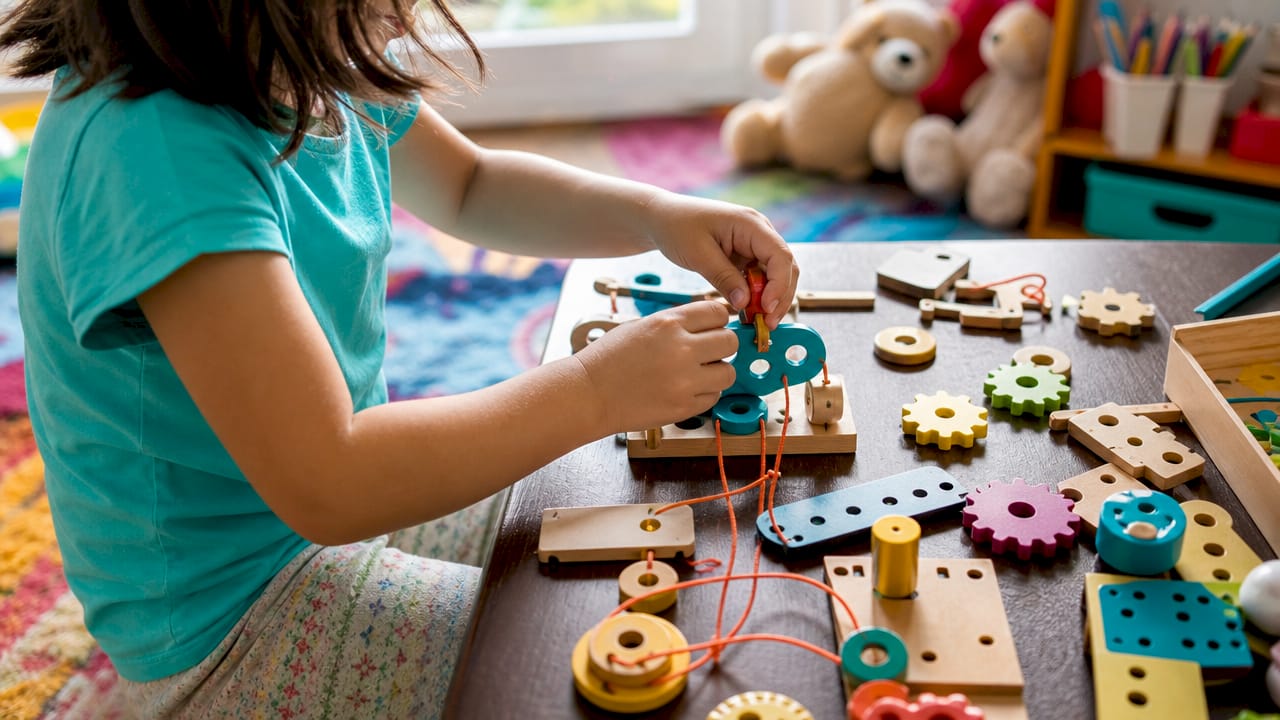
Screen-free toys also engage multiple sensory systems and require real decision-making, which yields intrinsic reward and builds frustration tolerance. This is the opposite of engineered digital stimulation, which delivers instant feedback that can undermine a child’s ability to persist through difficulty.
Social and emotional growth
Excess screen time is linked with delays in social skills, focus, sleep, and higher rates of behavioral issues in young children. Screen-free kits replace passive consumption with active engagement, giving children real opportunities to communicate, negotiate, and collaborate.
Pro Tip: Set aside 30 minutes after school for a screen-free kit activity. Children who build this habit early show stronger attention spans and better emotional regulation by the time they reach middle school.
Key developmental benefits of screen-free kits include:
- Critical thinking: Children solve real problems with physical constraints, not just tap through menus.
- Family bonding: Adults can participate alongside children without needing a device or an account.
- Fine motor skills: Handling physical components builds hand strength and coordination.
- Emotional resilience: Working through a failed experiment teaches persistence in a way a reset button never can.
- Imagination: Open-ended materials invite children to create scenarios, not just follow a script.
How do screen-free kits compare to screen-based learning tools?
The difference between screen-free and screen-based educational tools is not just about technology. It is about the quality of the learning experience at each stage of child development.
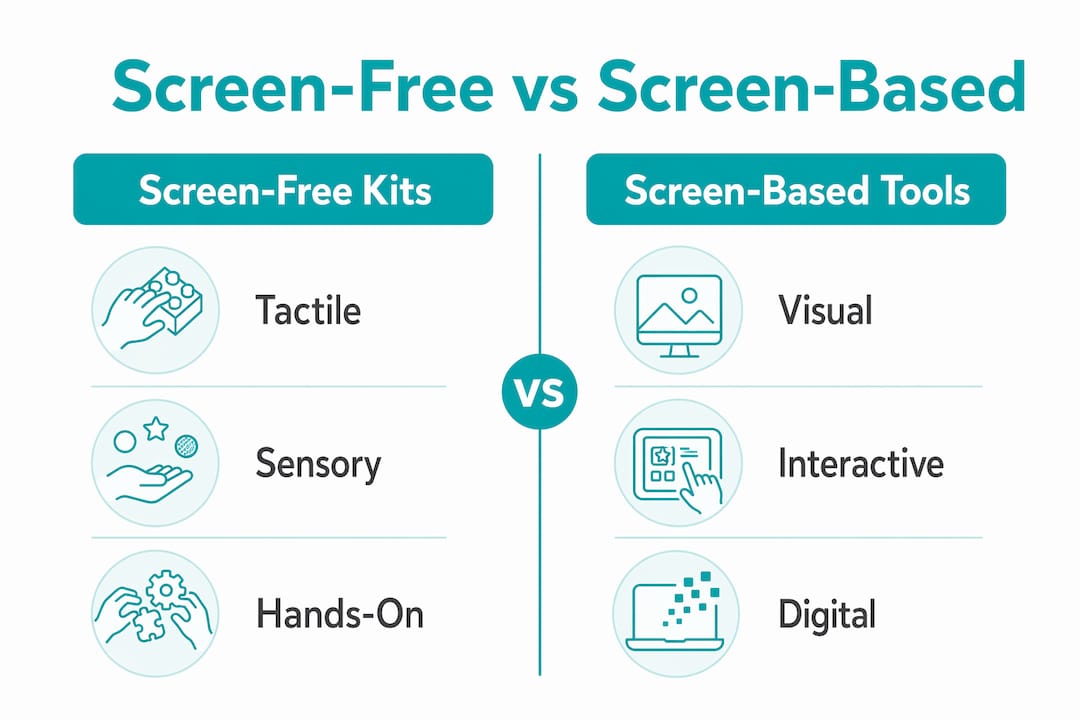
| Feature | Screen-free kits | Screen-based tools |
|---|---|---|
| Sensory engagement | Tactile, three-dimensional, multi-sensory | Primarily visual and auditory |
| Setup time | Immediate, no connectivity needed | Requires Bluetooth, apps, or firmware updates |
| Best age range | Ages 5–13, especially under 8 | More effective from age 8 onward |
| Social interaction | Encourages group and family play | Often individual and isolated |
| Brain circuits activated | Prefrontal cortex, motor, sensory | Primarily visual processing |
| Transition to digital | Builds foundational concepts first | Assumes prior conceptual understanding |
Children under 7 overwhelmingly prefer screen-free tools because of superior sensory feedback and tangible cause-and-effect learning in three-dimensional space. That preference is not just a matter of taste. It reflects how young brains are wired to learn through physical interaction before abstract representation.
Screen-free kits also teach foundational concepts like sequencing and conditional logic, which smoothly transition children to digital coding around age eight. This means non-digital toys are not a detour from technology literacy. They are the on-ramp. For older children in the 10–13 range, combining screen-free and screen-based tools gives the best of both worlds: physical intuition plus digital application.
The role of hands-on kits in STEAM learning is well-documented. Sensory feedback from physical materials creates memory anchors that abstract digital interfaces simply cannot replicate for young learners.
In what ways do screen-free kits support creativity and social skills?
Screen-free kits create the conditions for creativity and social development by removing the guardrails that digital tools impose. There is no right answer on a screen, no timer counting down, and no algorithm deciding what comes next.
Here are four specific ways these kits build creativity and social skills:
-
Intrinsic motivation through open-ended play. When a child builds something physical and it works, the reward comes from their own effort. Screen-free kits shift the reward system from engineered digital stimulation to the satisfaction of real accomplishment. That shift builds independence and genuine confidence.
-
Collaborative problem-solving. Group screen-free activities like building projects and science experiments promote communication and joint problem-solving more effectively than individual screen use. Children negotiate roles, share materials, and celebrate shared wins.
-
Role-play and identity building. Tactile materials invite children to step into characters and scenarios. A child who puts on a lab coat and calls herself a scientist is not just playing. She is building an identity. Teamgeniussquad’s kits use role-play tools like badges and certificates to make this identity shift concrete and memorable.
-
Fine motor development alongside social growth. Handling physical components, cutting, assembling, and measuring builds hand-eye coordination at the same time children practice turn-taking and verbal communication. These skills reinforce each other in ways that screen-based activities rarely achieve.
The screen-free strategies that work best combine physical challenge with social context. A child working alone on a puzzle builds focus. The same child working with a sibling or classmate builds focus and communication simultaneously.
What practical advantages do screen-free kits offer parents and educators?
Screen-free kits remove the friction that makes digital educational tools frustrating for adults and children alike. No Bluetooth pairing. No firmware updates. No app permissions to manage. A child can open the box and start learning in minutes.
Setup friction from Bluetooth and firmware issues frustrates children under 8 and often ends the learning session before it begins. Screen-free kits eliminate that barrier entirely, which means more consistent engagement and less adult troubleshooting.
Practical advantages for parents and educators include:
- Easy supervision: Adults can watch, guide, and participate without needing technical knowledge.
- Classroom flexibility: Kits work at desks, on floors, in small groups, or as independent stations.
- Accessibility for diverse learners: Screen-free STEAM kits are especially effective for neurodivergent children who benefit from tactile, sensory-rich experiences over screen-dependent instruction.
- Long-term engagement: Physical kits do not have battery life limits or subscription fees. Children return to them repeatedly, building on prior learning.
- Sensory development support: A parent’s guide to sensory play confirms that tactile engagement builds a stronger foundation for lifelong learning than screen-based tools alone.
Pro Tip: Rotate kits every two to three weeks in a classroom or home setting. Novelty sustains engagement, and returning to a previous kit after a break often reveals new levels of mastery children did not know they had.
Teamgeniussquad’s E³ Method (Engage, Encourage, Empower) is built around this practical reality. Each kit is designed so a child can pick it up, get absorbed, and feel successful without an adult needing to decode an app or troubleshoot a connection.
Key Takeaways
Screen-free kits are the most effective tool for building creativity, executive function, and social skills in children ages 5–13 because they activate brain circuits, remove setup barriers, and reward real effort.
| Point | Details |
|---|---|
| Brain development | Physical play activates prefrontal circuits that screen-based tools do not engage as effectively. |
| Developmental foundation | Screen-free kits teach sequencing and logic that ease the transition to digital learning around age 8. |
| Social skill building | Group screen-free activities build communication and collaboration better than individual screen use. |
| Practical ease | No Bluetooth or firmware issues means children engage immediately and consistently. |
| Neurodivergent accessibility | Tactile, sensory-rich kits support diverse learners, including children with dyslexia and dysgraphia. |
Why I believe screen-free kits are still the right starting point
Every few months, a new digital learning platform promises to replace physical play. I have watched children use both, and the difference is not subtle. A child working with a physical kit is present in a way that a child tapping a tablet simply is not. Their eyes are up. Their hands are moving. They are talking to the person next to them.
The research backs this up, but the observation is what sticks with me. Screen-free kits do not compete with technology. They build the mental and social foundation that makes technology useful later. A child who has never learned to persist through a physical challenge, negotiate with a peer, or feel the satisfaction of building something real will struggle to get the most out of any digital tool, no matter how well-designed.
What I find most compelling about Teamgeniussquad’s approach is the identity piece. Giving a child a lab coat and a certificate is not a gimmick. It is a signal that says: you are a scientist, a creator, a problem-solver. That signal lands differently when it comes from a physical experience rather than a screen notification. The confidence that builds from real, tactile success is the kind that travels with a child into every classroom and challenge they face.
My honest recommendation to parents and educators is this: start with screen-free. Build the foundation. Then add digital tools when the child is ready, around age 8, as a complement rather than a replacement. The children who thrive with technology are almost always the ones who first learned to thrive without it.
— Tita
Teamgeniussquad screen-free kits for curious young minds
Teamgeniussquad designs hands-on STEAM discovery kits that put real experiments, role-play tools, and confidence-building moments directly in a child’s hands. Every kit follows the trademarked E³ Method (Engage, Encourage, Empower), so children ages 5–13 move from curiosity to real discovery without a screen in sight.

Whether you are a parent building a learning routine at home or an educator looking for classroom-ready tools, Teamgeniussquad has kits designed for your goals. The STEM Electricity Lab Bundle brings real science concepts to life through hands-on experiments. For families near a Whole Foods location, the Teamgeniussquad launch page shows where to find kits in person. Every product is built to work right out of the box, with no setup frustration and no screen required.
FAQ
What age range benefits most from screen-free kits?
Children ages 5–8 benefit most from screen-free kits because their brains are wired for tactile, sensory learning before abstract digital interaction. Screen-free tools remain valuable through age 13 as a complement to digital learning.
How much screen-free activity do children need each day?
Expert coordinators at Sarasota Memorial recommend at least one hour of screen-free activity daily for improvements in social skills, critical thinking, and family bonding.
Can screen-free kits prepare children for coding and technology?
Screen-free kits teach foundational concepts like sequencing and conditional logic that ease the transition to digital coding around age 8, making them an effective first step toward technology literacy.
Are screen-free kits suitable for neurodivergent children?
Screen-free kits are especially well-suited for neurodivergent children because tactile and sensory-rich experiences support diverse learning styles, including those associated with dyslexia and dysgraphia.
Why do screen-free kits work better than apps for young children?
Setup friction from Bluetooth and firmware issues frustrates children under 8, while screen-free kits allow immediate engagement. Physical manipulation also activates brain circuits that screen-based tools do not reach as effectively.



Leave a comment
This site is protected by hCaptcha and the hCaptcha Privacy Policy and Terms of Service apply.