What Is Hands-On STEAM? A Guide for Parents
Hands-on STEAM is defined as an integrated, inquiry-based learning approach where children physically build, experiment, and solve real-world problems using science, technology, engineering, arts, and mathematics together. Unlike traditional subject-by-subject instruction, this method places children at the center of active discovery, where a single project might require measuring, sketching, testing, and reflecting all at once. STEAM activities work effectively in short, 20-minute daily sessions without specialized equipment. That means any parent or educator can start today, with what they already have at home or in the classroom.
What is hands-on STEAM and how does it differ from traditional learning?
Traditional STEM education teaches science, technology, engineering, and math as separate subjects. A child learns fractions in math class and then learns about plant growth in science class, with no connection between the two. True STEAM weaves all five disciplines into unified projects where children solve real problems using transdisciplinary methods. The arts are not decoration. They are functional tools for communication, design thinking, and creative problem-solving.
The difference shows up clearly in how children engage. In a traditional classroom, a child reads about bridges and answers questions. In a hands-on STEAM session, that same child designs a bridge from popsicle sticks, tests how much weight it holds, sketches the design, and writes about what failed and why. STEAM integrates communication, creativity, and real-world context in ways that isolated subject learning cannot replicate.
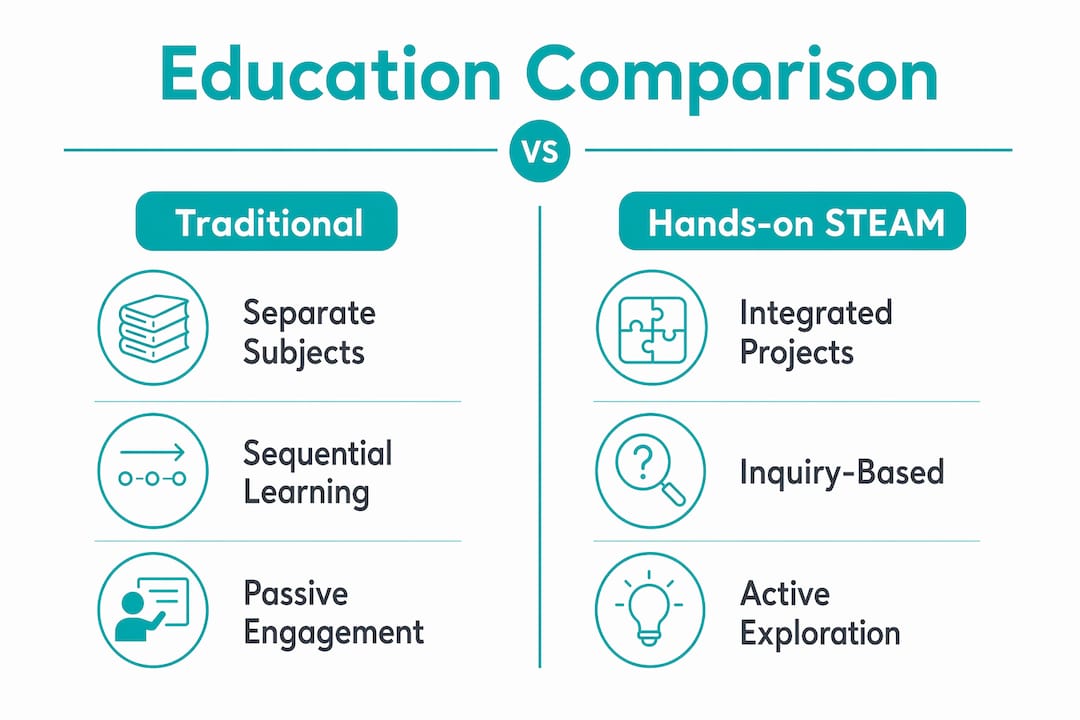
How STEAM compares to traditional education
| Feature | Traditional education | Hands-on STEAM |
|---|---|---|
| Subject delivery | Separate, sequential | Integrated, simultaneous |
| Child’s role | Passive receiver | Active builder and tester |
| Assessment focus | Correct answers | Process, iteration, and reflection |
| Materials needed | Textbooks, worksheets | Household items, open-ended supplies |
| Failure treated as | A mistake to avoid | A data point to learn from |
The most common misconception about STEAM is that it requires expensive kits or a dedicated lab. It does not. The second misconception is that “arts” means drawing or painting. In STEAM, arts include architecture, storytelling, graphic design, and any creative discipline that shapes how a solution looks, feels, or communicates.
Key benefits of hands-on STEAM over traditional instruction include:
- Children retain concepts longer because they experience them physically.
- Projects build critical thinking by requiring children to test and revise.
- Cross-subject integration mirrors how real-world problems actually work.
- Open-ended challenges build tolerance for uncertainty and creative risk.
What are practical examples of hands-on STEAM activities?
Concrete projects make the concept real. Many effective STEAM activities use common household materials, which removes cost as a barrier and encourages open-ended design rather than following a script. Here are five projects that work well for children ages 5–13, organized by increasing complexity.
- Marble roller coaster. Use cardboard tubes, tape, and a marble. Children design a track, test the slope, and redesign when the marble stops. This covers physics, engineering, and spatial reasoning in one session.
- Volcano science lab. Baking soda, vinegar, and a clay or cardboard cone teach chemical reactions. Adding color and storytelling (why is the volcano erupting?) brings arts and literacy into the experiment.
- Bridge engineering challenge. Give children 20 index cards and 30 cm of tape. Ask them to build a bridge that holds the most pennies. The constraint forces creative problem-solving and iterative testing.
- Solar oven from a pizza box. Line a pizza box with foil, cover the opening with plastic wrap, and use it to melt chocolate. This project covers solar energy, reflection, and heat transfer.
- Storyboard a machine. Ask children to draw and describe an imaginary machine that solves a problem they care about. This builds design thinking, writing, and engineering vocabulary simultaneously.
Each project above is repeatable. A child who builds a bridge once will want to build a stronger one next time. That cycle of iteration is exactly where the deepest learning happens.
Pro Tip: Set a “failure celebration” rule in your home or classroom. When a design does not work, ask the child: “What did you learn?” Then write it down. Failure is a valuable data point in STEAM, and naming what was learned turns frustration into momentum.
How does hands-on STEAM support children with learning differences?
Hands-on STEAM shifts focus from rote tasks to tactile manipulation, which directly benefits children with dyslexia, dysgraphia, ADHD, and other learning differences. When a child who struggles with reading can still build a working circuit or design a bridge that holds weight, they experience competence. That experience of competence is the foundation of confidence.
The role of hands-on kits in STEAM learning is especially significant for neurodivergent children because the learning happens through doing, not through decoding text or sitting still. A child with ADHD who cannot focus on a worksheet for ten minutes can often sustain deep focus on a building challenge for thirty minutes or more. The physical engagement regulates attention in a way that passive instruction cannot.
“STEAM education is not about adding more content. It is about doing what works best for diverse brain types by incorporating play, experimentation, and child-led learning.” This insight from educator Danielle Mimbs captures why hands-on STEAM reaches children that traditional schooling often misses.
For caregivers supporting children with learning differences, inclusive STEAM practices make a measurable difference. Practical steps include:
- Choose projects with multiple entry points so children can contribute at their level.
- Reduce writing pressure by allowing children to draw, build, or speak their reflections.
- Celebrate the process, not just the finished product, to reinforce that effort matters.
- Use role play and identity tools (lab coats, scientist badges) to help children see themselves as capable innovators.
Teamgeniussquad was built on exactly this understanding. Inspired by a real family journey with dyslexia and dysgraphia, its E³ Method (Engage, Encourage, Empower) guides children from first curiosity to genuine confidence through structured but open-ended discovery.
What are best practices for teaching STEAM at home and in the classroom?
Learning how to teach STEAM hands-on does not require a curriculum overhaul. It requires consistency, low-prep materials, and a willingness to let children lead. Short digital activities paired with physical projects maintain holistic STEAM learning and balance screen time effectively. The key is that screens support the hands-on work, not replace it.
Setting up a STEAM center at home or in a classroom is simpler than most parents expect. STEAM centers encourage creativity, engineering skills, and cross-curricular learning using easily swappable, open-ended materials. A single shelf or bin with rotating supplies is enough to get started.
Pro Tip: Rotate your STEAM materials monthly. A bin of straws and tape one month, then clay and toothpicks the next. Fresh materials reset curiosity and prevent the “I’ve done this before” response that shuts down creative thinking.
Building a weekly STEAM routine
| Session type | Frequency | Duration | Example activity |
|---|---|---|---|
| Quick experiment | 3–4 times per week | 15–20 minutes | Baking soda and vinegar reactions |
| Design challenge | Once per week | 30–45 minutes | Bridge or tower building |
| Reflection and journaling | After each session | 5–10 minutes | Draw or describe what you learned |
| Extended project | Once per month | 60–90 minutes | Solar oven or roller coaster build |
Additional practices that strengthen STEAM learning at home include:
- Ask open questions instead of giving answers. “What do you think will happen if you add more weight?” teaches more than explaining the physics yourself.
- Use the home learning guide for parents to track materials and session ideas without spending hours on prep.
- Connect STEAM to your child’s interests. A child who loves dinosaurs can engineer a fossil dig, study paleontology, and write a field report all in one afternoon.
- Allow unfinished projects. Not every session needs a final product. The thinking process has value on its own.
Key Takeaways
Hands-on STEAM is the most effective learning approach for children ages 5–13 because it integrates science, arts, and engineering into real projects that build both skills and confidence.
| Point | Details |
|---|---|
| Integrated by design | STEAM fuses all five disciplines in one project, not five separate lessons. |
| No expensive materials needed | Common household items like cardboard and tape are enough to start today. |
| Failure is part of the method | Iteration and redesign are built into STEAM, not signs that something went wrong. |
| Supports diverse learners | Tactile, hands-on projects reduce anxiety and build confidence for neurodivergent children. |
| Consistency beats intensity | Short daily sessions of 15–20 minutes outperform occasional long lessons. |
Why hands-on STEAM changed how I think about learning
I used to believe that the best learning happened in quiet rooms with structured worksheets. I was wrong. The moment I watched a seven-year-old who “hated school” spend forty-five uninterrupted minutes redesigning a cardboard bridge that kept collapsing, I understood something that no education textbook had fully communicated to me: children do not resist learning. They resist boredom.
What hands-on STEAM does differently is that it respects a child’s intelligence. It gives them a real problem, real materials, and real freedom to fail and try again. The arts component is the piece most adults underestimate. When a child has to explain their design, draw it, or name it, they are processing the experience at a deeper level. That reflection is where the learning locks in.
The biggest pitfall I see parents and educators fall into is over-directing the project. The instinct to help is natural, but stepping in too quickly robs the child of the productive struggle that builds resilience. My advice: give the challenge, set the timer, and sit on your hands. You will be surprised by what children create when they trust that you trust them.
The benefits of STEAM for kids go far beyond academic performance. Children who practice hands-on STEAM regularly develop a relationship with curiosity itself. They start to see problems as interesting rather than threatening. That mindset is the most valuable thing any parent or educator can give a child.
— Tita
Teamgeniussquad’s hands-on STEAM kits for young innovators
Teamgeniussquad designs screen-free STEAM discovery kits built specifically for children ages 5–13, including those who learn differently. Each kit uses the trademarked E³ Method (Engage, Encourage, Empower) to guide children from first experiment to genuine confidence, with no specialized equipment required.

The STEM-STEAM Electricity Lab Bundle is one of Teamgeniussquad’s highest-priority kits, combining real circuit-building experiments with role-play tools like lab coats and scientist badges. Children do not just complete activities. They step into the identity of a young innovator. Every kit is designed to work alongside household materials, making hands-on STEAM learning accessible for any family or classroom budget.
FAQ
What is hands-on STEAM education for kids?
Hands-on STEAM education is an integrated learning approach where children physically build, experiment, and solve problems using science, technology, engineering, arts, and mathematics together. It replaces passive instruction with active discovery through real projects.
How do I teach STEAM at home with no special equipment?
Start with household materials like cardboard, tape, and recycled containers. Short sessions of 15–20 minutes work well, and open-ended challenges like bridge building or volcano labs require no special purchases.
What age is hands-on STEAM best suited for?
Hands-on STEAM works effectively for children ages 5–13, with projects scaled to match developmental stages. Younger children benefit from sensory and building activities, while older children can tackle design challenges and extended experiments.
How does STEAM help children with learning differences?
STEAM shifts learning from rote memorization to tactile problem-solving, which reduces anxiety and builds confidence for children with dyslexia, dysgraphia, and ADHD. The focus on doing rather than reading or writing creates alternative paths to success.
How often should children do STEAM activities?
Short, consistent sessions of 15–20 minutes three to four times per week build stronger habits than occasional long sessions. One extended design challenge per week adds depth without overwhelming busy schedules.



Leave a comment
This site is protected by hCaptcha and the hCaptcha Privacy Policy and Terms of Service apply.