
Identity-Driven STEM Ideas for Kids Ages 5–13
Identity-driven STEM ideas are defined as learning activities that connect STEM concepts directly to a child’s cultural background, personal experiences, and community context. This approach, formally known as culturally responsive STEM education, does more than teach science or math. It tells every child that their story belongs in the lab. Frameworks like STEM Identity Literacy, developed through the work of researchers like Dr. Sherita Flake, and Justice-Centered Tasks show that when children see themselves in STEM, they stay in STEM. Research confirms that STEM identity indicators including commitment, exploration, affirmation, social recognition, and reconsideration correlate directly with higher persistence. For educators and parents of children ages 5–13, that connection is the most powerful tool you have.
1. What makes STEM activities identity-driven?
Identity-driven STEM activities share five core indicators: commitment, exploration, affirmation, social recognition, and reconsideration. Each indicator signals that a child is not just completing a task but building a relationship with STEM as part of who they are.

Culturally responsive teaching practices (CRTP) are the backbone of this approach. A study of 349 Hispanic and Latinx undergraduates across 12 institutions confirmed that CRTP protects STEM identity by aligning ethnic and STEM identities rather than forcing students to choose between them. That alignment starts in childhood, which is why the design of activities for ages 5–13 matters so much.
Assets-based framing is the design principle that ties everything together. It treats a child’s home culture, family knowledge, and community context as raw material for engineering solutions, not as obstacles to overcome. The opposite, deficit framing, tells children what they lack. Assets-based framing tells them what they bring.
- The activity connects to a real problem in the child’s community or family life.
- The child’s cultural background is a resource, not a footnote.
- Success is defined by curiosity and process, not speed or innate talent.
- Reflection is built in, so children can articulate what they discovered about themselves.
Pro Tip: Avoid framing any activity as “catching up.” Language like “you already know this from home” activates prior knowledge and signals belonging far more effectively than remediation language.
2. Culturally relevant engineering projects
Culturally relevant engineering asks children to solve problems that matter in their own neighborhoods. A child in a community with limited green space might design a rooftop garden using cardboard, soil, and seeds. A child whose family cooks traditional foods might engineer a better way to store or dry herbs. The STEM concepts, structural load, evaporation, and material properties, are identical to any standard curriculum. The difference is that the child owns the problem.
This type of identity-focused STEM project builds engineering thinking and cultural pride at the same time. Children who see their community as a design challenge rather than a limitation develop a fundamentally different relationship with problem-solving.
3. Storytelling with data
Data storytelling combines math, literacy, and personal narrative. Children collect data about something meaningful to them, such as the languages spoken in their home, the foods their family eats most often, or the animals in their neighborhood, and then visualize it through charts, drawings, or digital tools. The math is real. The story is theirs.
This activity works especially well for ages 8–13, when children begin to develop abstract thinking. It also integrates naturally with STEAM literacy practices, reinforcing reading and writing alongside data analysis. When a child presents their data story to peers, they experience the social recognition that research links directly to STEM persistence.
4. Community-based environmental science
Environmental science becomes identity-driven when children investigate their own environment. Ask a child to test the water quality in their neighborhood, track air quality near a busy road, or map the trees in their block. These are real scientific methods applied to real places the child knows and cares about.
Connecting science activities to children’s lives increases both engagement and persistence. Children who study their own environment develop a sense of scientific authority. They are not learning about someone else’s problem. They are the expert on their own community.
5. Art-integrated coding
Coding becomes identity-driven when the output reflects the child’s own visual culture. Children can use tools like Scratch to animate a traditional dance, recreate a pattern from their cultural heritage, or tell a family story through a simple game. The coding logic is the same as any other project. The creative direction is entirely personal.
This activity is particularly effective for visual learners and children who struggle in text-heavy environments. Teamgeniussquad’s approach to STEAM integration recognizes that combining art with technology gives children who think in images a legitimate path into computational thinking. The result is both a working program and a piece of cultural expression.
6. Heritage-inspired robotics
Robotics challenges become identity-driven when the design brief draws from cultural heritage. Children might build a robot inspired by a traditional craft, a cultural celebration, or a historical figure from their community. A child whose family heritage includes weaving might design a robot arm that mimics a loom’s motion. A child inspired by a community elder might build a robot that delivers messages.
Experiential learning connected to identity deepens STEM engagement in ways that abstract challenges cannot. When the design brief has personal meaning, children iterate more persistently and take more creative risks.
7. Identity-affirming math games
Math games become identity-driven when the numbers, scenarios, and characters reflect the child’s world. Create a game where children calculate the cost of ingredients for a family recipe, measure fabric for a traditional garment, or track the score in a game from their cultural background. The arithmetic is standard. The context is affirming.
This approach directly counters the research finding that high-achievement STEM environments can undermine identity by framing mastery as innate talent. When math is embedded in familiar, valued contexts, children associate competence with effort and connection rather than with speed or natural ability.
8. Collaborative invention challenges
Invention challenges become identity-driven when teams are asked to solve a problem that affects their community and when every team member’s perspective is treated as expertise. Children might invent a device to help an elderly neighbor, design a tool for a local small business, or create a solution to a problem they have personally experienced.
Collaborative projects and active learning link directly to social affirmation and increased STEM interest. When children work together on a problem that matters to all of them, the social recognition they receive from peers reinforces their STEM identity far more durably than individual test scores.
9. How identity-driven STEM boosts creativity and confidence
Affirming a child’s identity in STEM creates a sense of belonging that directly increases intrinsic motivation. When children see their culture, language, and family knowledge as assets in the lab, they take more creative risks. They ask more questions. They persist through failure because the problem feels worth solving.
“Equity efforts in STEM fail without ideological shifts that disrupt deficit narratives and systemic bias against girls and minorities.” — Using Culturally Relevant Pedagogy and BlackCrit in STEM
That shift is not just philosophical. It produces measurable changes in how children engage. Identity-driven activities support risk-taking and curiosity because children are no longer performing for an external standard. They are solving for something they already care about. That internal motivation is the engine of genuine creativity.
10. Practical tips for educators and parents
Educators and parents are the primary architects of identity-driven STEM learning. Educators who develop STEM identity literacy through persistent self-reflection and equity awareness create more inclusive learning spaces than those who rely on curriculum alone. That literacy starts with knowing your own cultural assumptions about who belongs in STEM.
- Audit your current STEM activities for whose culture and context they center.
- Ask children directly: “What problem in your neighborhood would you like to solve?”
- Build in reflective dialogue after every activity so children can connect what they learned to who they are.
- Use STEM-STEAM books and puzzles that feature characters and scientists from diverse backgrounds.
- Address institutional resistance by framing identity-driven approaches as evidence-based, not political. A systematic review of 41 documents confirms that teacher readiness, policy support, and identity-aligned resources are all required for successful implementation.
Pro Tip: Successful identity-driven STEM interventions must be multifaceted and context-sensitive, helping children link their real-world hobbies and interests directly to STEM challenges. Start with one activity per month and build from there.
Key takeaways
Identity-driven STEM education works best when cultural context, assets-based framing, and reflective dialogue are built into every activity from the start.
| Point | Details |
|---|---|
| Start with identity, not content | Design activities around the child’s community and culture before selecting the STEM concept. |
| Use assets-based framing | Treat home culture and family knowledge as scientific raw material, not background noise. |
| Build in social recognition | Collaborative and presentation-based activities reinforce STEM identity more durably than solo tasks. |
| Develop educator identity literacy | Teachers and parents who reflect on their own cultural assumptions create more inclusive STEM spaces. |
| Counter ability myths early | Frame success as curiosity and effort, not speed or innate talent, to protect long-term STEM persistence. |
Why I believe identity is the missing variable in STEM education
Most STEM programs I have seen are built around content mastery. They ask: can this child solve the problem? The better question is: does this child believe they belong in the room where problems get solved? Those are two completely different questions, and only one of them predicts long-term success.
What I find most striking about the research is that identity-driven approaches do not lower the bar. They raise engagement, persistence, and creative output. A child who designs a robot inspired by their grandmother’s weaving tradition is doing the same engineering as any other child. But they are also building a story about themselves as a maker, a thinker, and an innovator. That story is what carries them through the hard parts.
The uncomfortable truth is that most STEM curricula were not designed with every child’s identity in mind. Changing that does not require a complete overhaul. It requires intentional choices: the problem you pose, the scientist you highlight, the context you use for a math problem. Those small choices accumulate into a child’s sense of whether STEM is for them.
Teamgeniussquad was built on exactly this belief. The E³ Method, Engage, Encourage, Empower, is not just a teaching sequence. It is a commitment to meeting every child where their identity already lives and building from there. Every educator and parent reading this has the power to make that same commitment, one activity at a time.
— Tita
STEM kits that put identity at the center of discovery
Teamgeniussquad designs hands-on, screen-free STEAM kits built specifically for children ages 5–13 who need to see themselves in science. Each kit uses the E³ Method to move children from curiosity to confidence through real experiments, role-play, and reflection.
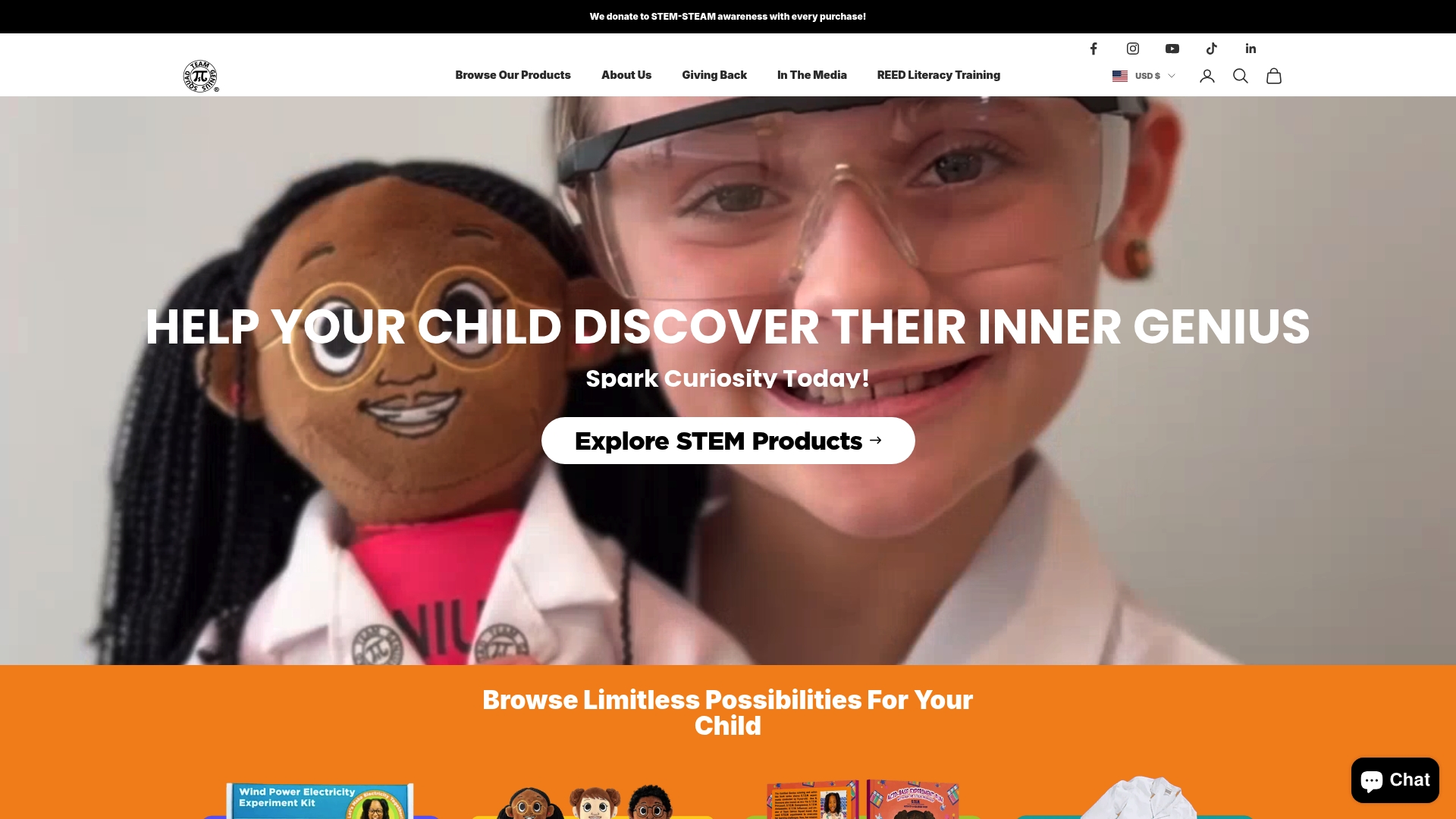
The STEM-STEAM Electricity Lab Bundle gives children a tactile, identity-affirming path into electrical engineering. For families looking for a broader collection, the Teamgeniussquad Whole Foods Launch page features kits designed to build both STEM skills and the belief that every child is already a scientist. These are not just experiments. They are the beginning of a child’s identity as an innovator.
FAQ
What are identity-driven STEM ideas?
Identity-driven STEM ideas are learning activities that connect STEM concepts to a child’s cultural background, personal experiences, and community context. They use frameworks like culturally responsive teaching to build both technical skills and a lasting sense of belonging in STEM.
Why does identity matter in STEM education?
Research shows that STEM identity indicators like commitment, affirmation, and social recognition correlate directly with higher persistence in STEM fields. Children who see their culture and identity reflected in STEM activities are more motivated and more likely to continue in STEM long term.
How can parents support identity-driven STEM at home?
Parents can start by connecting math and science to everyday family life, such as cooking, gardening, or community events. Using STEAM resources for parents that center diverse identities helps children build confidence alongside skills.
What age group benefits most from identity-focused STEM projects?
Children ages 5–13 benefit significantly because this is the window when STEM identity forms. Activities designed for this age group that affirm cultural identity and reward curiosity over speed produce the strongest long-term outcomes.
How do educators overcome resistance to culturally responsive STEM?
Frame culturally responsive STEM as evidence-based practice. A systematic review of 41 documents confirms that teacher readiness and identity-aligned resources are essential for successful implementation, making the case on academic grounds rather than ideological ones.



Leave a comment
This site is protected by hCaptcha and the hCaptcha Privacy Policy and Terms of Service apply.