Win STEM Grants for Teachers in the U.S.: What Reviewers Check
The fastest path to STEM classroom funding runs through four channels: federal programs like the National Science Foundation and the U.S. Department of Education, national foundations and corporations such as Toshiba America Foundation and the Burroughs Wellcome Fund, state and local STEM grant programs, and Grants as the portal tying federal opportunities together. Mini-grants tend to run $500 to $5,000, foundation awards can reach $25,000 or more, and NSF multi-year awards climb into the millions. Your first move is simple: get your principal’s sign-off lined up before you write a single word, then shortlist two or three grants that actually match your grade band.
TL;DR:
- Most classroom teachers should focus on foundation-targeted grants with awards around $5,000, as federal multi-year awards often cater to institutions rather than individuals.
- Applying early for principal approval and maintaining an organized tracking system can prevent missing deadlines and improve application success.
- A clear, itemized budget and a detailed project narrative with standards alignment and evaluation plans are crucial for review approval.
- Building sustainability into proposals by demonstrating long-term classroom integration and peer training increases the chance of funding.
- Starting with small local grants and building a track record can help secure larger awards in the future.
Table of Contents
- Top National STEM Grants for Teachers at a Glance
- How to Find STEM Grants That Actually Fit Your Classroom
- What a STEM Grant Application Package Actually Requires
- Writing a STEM Grant Proposal That Actually Gets Funded
- State and Local STEM Grant Examples Worth Studying
- Managing Your Grant Award and Building Momentum for the Next One
- How Team Genius Squad Fits Into a Grant-Funded STEM Classroom
- Small Grants, Big Classroom Payoff With Team Genius Squad Kits
- Bookmark These Sources Before Your Next Application
- Sources
Top National STEM Grants for Teachers at a Glance
You don’t need to chase every opportunity that lands in your inbox. You need to know which two or three programs fit your classroom, your grade band, and your bandwidth for paperwork. Here’s how the biggest national players stack up.
Federal programs carry the largest checks but the longest timelines. NSF’s Robert Noyce Teacher Scholarship Program funds multiple tracks, including scholarships, teaching fellowships, master teaching fellowships, and research, aimed at recruiting and retaining K-12 STEM teachers. Awards range widely because they fund institutions and partnerships rather than individual classroom projects, so this program suits a district or university partner more than a lone teacher applying solo. NSF’s broader K-12 portfolio, including its Advancing Informal STEM Learning (AISL) line, follows a similar pattern: big, multi-year, and best pursued alongside an institutional partner.
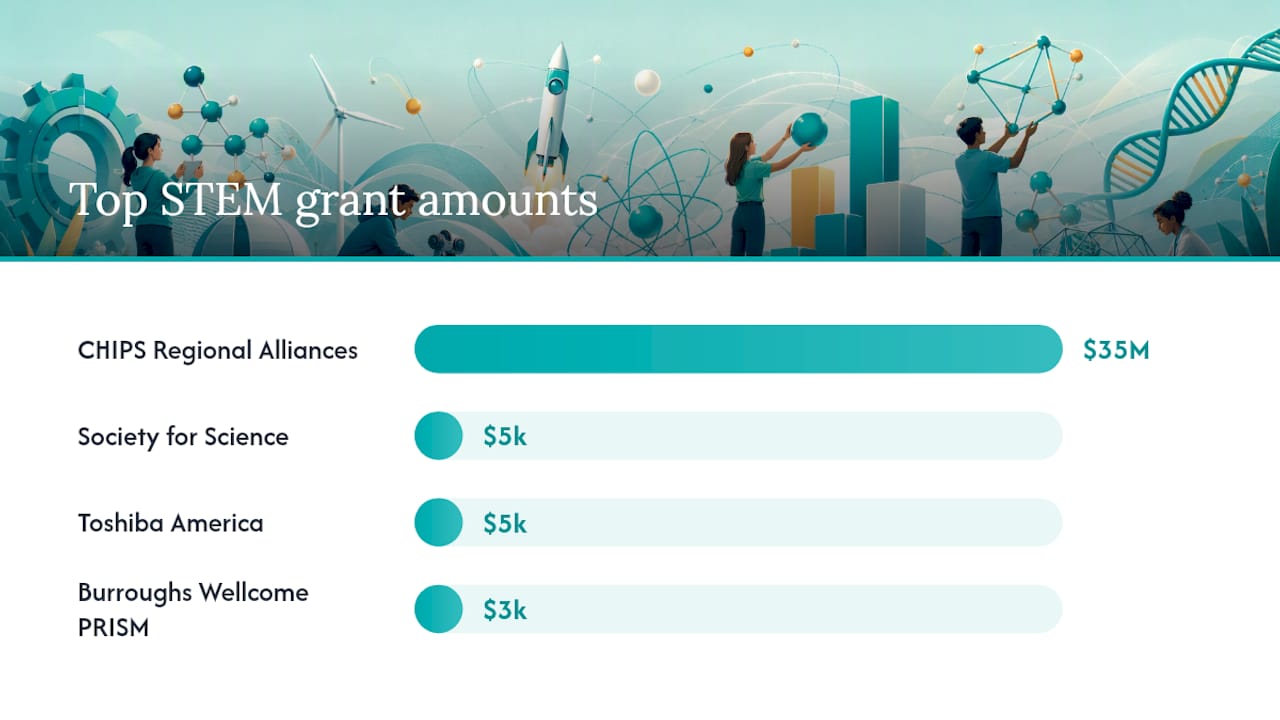
The National STEM Teacher Corps Pilot Program, funded through the CHIPS Act, takes a different approach. It funds Regional Alliances that recruit and support teacher leaders, with anticipated funding up to $35 million spread across alliances and member stipends. If your district participates in a regional alliance, this is worth watching. Individual teachers don’t apply directly, but they benefit through stipends and peer networks once an alliance forms in their region.
Foundation and teacher-targeted grants are where most classroom teachers should start. Three programs stand out for direct, teacher-level applications:
- Society for Science STEM Research Grants offer up to $5,000 for middle and high school teachers supporting authentic student research. Over eight years, the program has awarded $775,000 to 367 teachers, and it requires school fiscal sponsorship plus principal commitment.
- Toshiba America Foundation grants for grades 6 through 12 typically max out around $5,000, with a strong emphasis on project-based learning. The foundation explicitly excludes general-purpose technology purchases, so a proposal built around a laptop cart won’t get far.
- Burroughs Wellcome Fund’s PRISM program awards up to $3,000 for hands-on, inquiry-based science and math projects, with an additional allowance sometimes available for professional development. Eligibility can be state-specific, so check the current RFP before you invest hours in an application.
Grants.gov is your hub for anything federal, but not every worthwhile grant lives there. Foundations like Toshiba and Burroughs Wellcome run their own application portals, and you’ll apply directly on their sites. Use Grants.gov to search and set alerts for federal opportunities, then bookmark individual foundation pages for anything outside the federal system. Classroom-level requests, the kind funding a single unit or lab experience, almost always come from foundations or state programs rather than NSF’s institutional-scale awards.
How to Find STEM Grants That Actually Fit Your Classroom
Searching for STEM funding for educators without a system wastes hours. You end up rereading the same three grant databases every few weeks, half-remembering deadlines, and missing programs that don’t show up in a basic web search. A little structure fixes that fast.
Start with layered searching rather than one big search. Grants.gov covers federal money, but you’ll also want to check individual NSF program pages directly, since some solicitations post there before they’re fully indexed elsewhere. Foundation “apply” pages, your state education agency’s RFP listings, statewide afterschool network newsletters, and general STEM grant directories round out a reasonably complete search.
- Set email alerts on Grants.gov and on any foundation page you visit more than once.
- Check your state education agency’s grant page monthly. State STEM grant programs often post RFAs on a fixed annual cycle.
- Ask your district’s grant office if one exists. Many districts already track opportunities and may co-sign applications.
- Look at local corporate and utility programs. Regional STEM initiatives, like the APS/Phoenix Suns STEM Teacher Grants in Arizona, rarely show up in national directories but often have lighter applications than federal programs.
- Join a statewide afterschool or STEM educator network. These groups frequently forward grant announcements that never hit mainstream searches.
Timing varies by source. Foundation and teacher mini-grants often run on rolling deadlines, so you can apply as soon as your project is ready. State and federal RFAs tend to follow a seasonal calendar, frequently opening in late summer or early fall for the following school year.
Pro Tip: Build one spreadsheet with columns for deadline, award size, eligibility, required attachments, and application status. Update it the same day you find a new opportunity, not the week before the deadline. A tracker this simple keeps you from discovering, three days too late, that a program closed applications in September.
What a STEM Grant Application Package Actually Requires
Every education grant for teachers asks for some version of the same core documents, even when the format changes. Knowing this in advance saves you from scrambling the week before a deadline.
The itemized budget carries more weight than most first-time applicants expect. Reviewers want line items tied to specific costs, not a lump sum. If you’re requesting $2,000 for a classroom kit, break it down: unit cost times quantity, shipping, consumables, and any professional development time you’re asking the grant to cover. Vague budgets read as unplanned projects.
The project narrative typically follows a predictable structure: learning objectives, planned activities, alignment to state or national standards, an assessment or evaluation plan, and a timeline. Programs like Society for Science’s STEM Research Grants require exactly this combination, plus proof of full-time employment and a memorandum of understanding signed by a principal or district official.
Administrative paperwork trips up more applicants than weak writing does. Here’s what typically needs to be locked in before you submit:
- Proof of employment, usually a simple letter or district ID confirmation.
- A principal or district-signed MOU or letter of support.
- A fiscal sponsor or nonprofit affiliation if the funder requires funds to flow through an organization rather than an individual.
- Confirmation of any word or character limits in the narrative section, since some portals cut text off without warning.
- A final check that every attachment is in the correct file format for the specific submission mechanism, whether that’s a PDF upload or a Grants.gov workspace.
| Application component | What reviewers check | Common pitfall |
|---|---|---|
| Itemized budget | Line-item costs with clear justification | Lump-sum requests with no breakdown |
| Project narrative | Objectives, standards alignment, evaluation plan | Vague or immeasurable outcomes |
| Principal/district MOU | Signature obtained before deadline | Last-minute signature requests that fail |
| Sustainability plan | How the project continues past the grant | No plan for what happens after funds run out |
Obtain that principal signature early. Applicants often assume a last-minute sign-off will be available, and it frequently isn’t. Save the signed MOU as a completed attachment the moment you have it.
Writing a STEM Grant Proposal That Actually Gets Funded
A proposal that reads like a shopping list rarely wins. Reviewers can spot a one-off equipment purchase from a mile away, and most funders have seen thousands of them. What separates a funded application from a rejected one usually comes down to three things: sustainability, measurement, and realistic framing.
Sustainability means showing what happens after the check clears. Reviewers want to see the kit, curriculum, or lab experience embedded into your teaching for years, not used once and shelved. Mention how the materials integrate into existing lesson plans, how you’ll train colleagues to use them, and how the resource gets shared beyond your own classroom.
- Name the specific unit or course where the project lives permanently, not just “science class.”
- Describe a simple, believable student outcome. “80% of students complete a hands-on investigation and submit a lab report” beats “students will love science.”
- Include a reporting cadence: a midyear check-in and an end-of-year summary satisfy most funder reporting requirements.
- Show in-kind support. Existing classroom time, a colleague’s volunteer hours, or shared lab space all count and make your ask look leaner.
NSF and many foundation reviewers explicitly favor proposals built around teacher-leader or cohort models over solo purchases. NSF’s own guidance on STEM teacher leadership treats capacity-building, training peers, sharing materials across a grade team, as a stronger investment than a single classroom’s equipment. Programs run by groups like the Knowles Teacher Initiative back this up: cohort-based professional development produces better retention and actual classroom change than isolated, one-teacher training.
Pro Tip: Apply for a small local grant first, even if you’re ultimately aiming for something bigger. A completed $1,500 project with real evaluation data becomes evidence that you can execute, and reviewers weigh a track record heavily when your next application asks for five figures. This is exactly how Society for Science’s applicant pool tends to build toward larger awards over time.
State and Local STEM Grant Examples Worth Studying
National programs get the headlines, but state STEM grant programs and regional corporate grants often have friendlier odds and faster turnaround. Two examples show how differently these can be structured.
- Nevada’s K-5 STEM Grant offers classroom awards up to $2,000 and program-level awards up to $25,000, using a reimbursement structure that requires you to spend first and get reimbursed after submitting documentation. It’s limited to Nevada public and charter elementary schools and requires a documented principal commitment before submission.
- APS/Phoenix Suns STEM Teacher Grants provide up to $2,500 for K-12 public and charter teachers within the APS service territory in Arizona, drawing from a $50,000 annual pool. The program lists specific exclusions and ties evaluation to measurable, interdisciplinary project goals.
If you’re adapting a national-style application to a state RFA, expect tighter word limits, a different sign-off template than you’re used to, and sometimes a fiscal agent requirement if you’re not applying through your school directly. Read the RFA’s formatting rules line by line. State reviewers often disqualify strong projects over a missed word count rather than weak content.
Managing Your Grant Award and Building Momentum for the Next One
Winning the grant is the beginning of the paperwork, not the end of it. Most funders expect financial reporting that matches your original budget line by line, and falling behind on receipts is the fastest way to jeopardize future eligibility with that same funder.
- Match every receipt to its original budget line the week you make the purchase, not months later.
- File financial reports on the funder’s schedule. Many require a midyear update and a final report within 30 to 60 days of project completion.
- Collect before-and-after evidence as you go: student work samples, brief teacher reflections, and simple pre/post assessment data.
- Use that evaluation data explicitly in your next application’s narrative. A funder can see the difference between “we hope this works” and “here’s what happened last time.”
- If a pilot succeeds, bring the results to your district curriculum office. Showing cost-per-student impact is often what converts a one-year pilot into a line item in next year’s budget.
Every report you file well becomes leverage for the application after it.
How Team Genius Squad Fits Into a Grant-Funded STEM Classroom
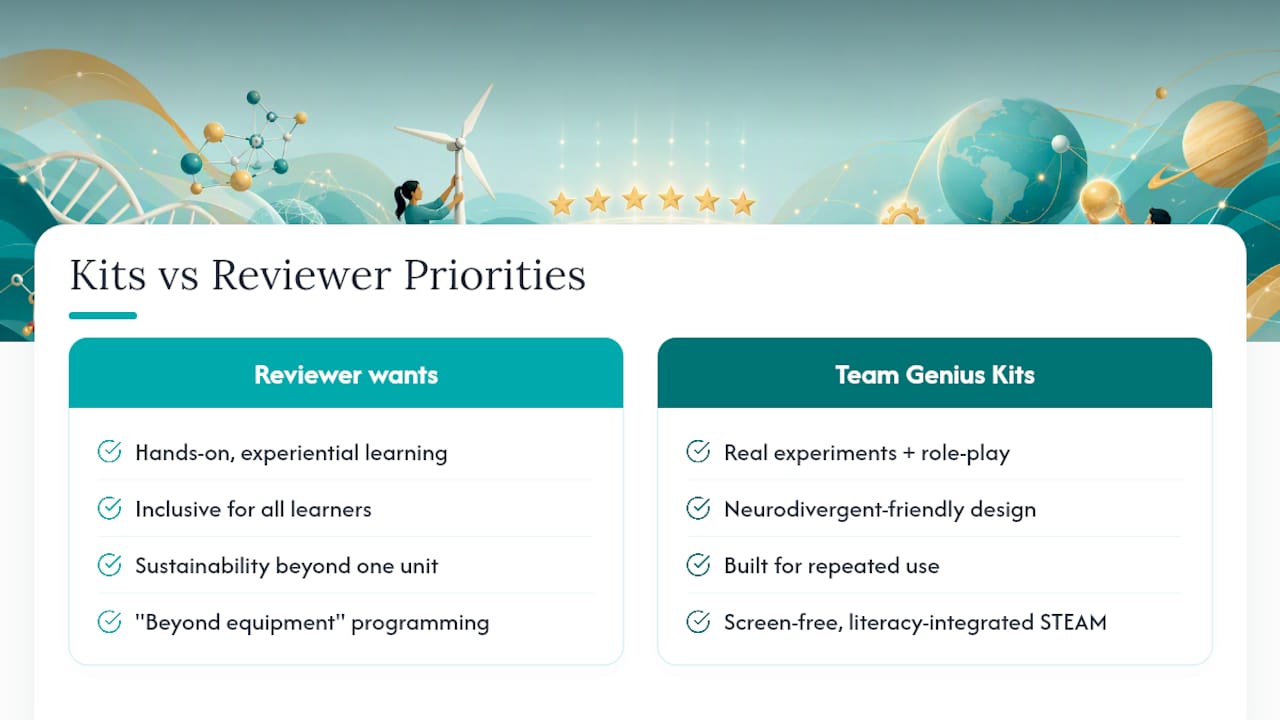
Grant reviewers consistently reward projects that are hands-on, inclusive, and built to outlast a single unit, exactly the criteria Team Genius Squad kits were designed around. In a budget narrative, describe the kits as screen-free, literacy-integrated STEAM experiences that pair real experiments with role-play and reflection, which speaks directly to the “beyond equipment” language most reviewers want to see, as outlined in our guide to supporting STEM education programs.
For the professional development line item, budget time for teachers to walk through the accompanying lesson plans before rollout. That PD time is exactly what funders like PRISM allow you to request alongside materials. And because the kits are built from a neurodivergent-friendly design philosophy, your sustainability section can honestly argue the project supports every learner, not just your strongest ones, long after the grant period ends.
— Tita
Small Grants, Big Classroom Payoff With Team Genius Squad Kits
If you’ve been reading this and wondering whether your $1,500 mini-grant is even worth applying for, here’s the honest answer: it’s often the perfect size for exactly what Team Genius Squad builds. Unlike a laptop cart or a one-time field trip, our kits are classroom-ready out of the box, come with lesson plans and PD notes already written, and check every box reviewers look for: hands-on, inclusive, screen-free, and reusable year after year.
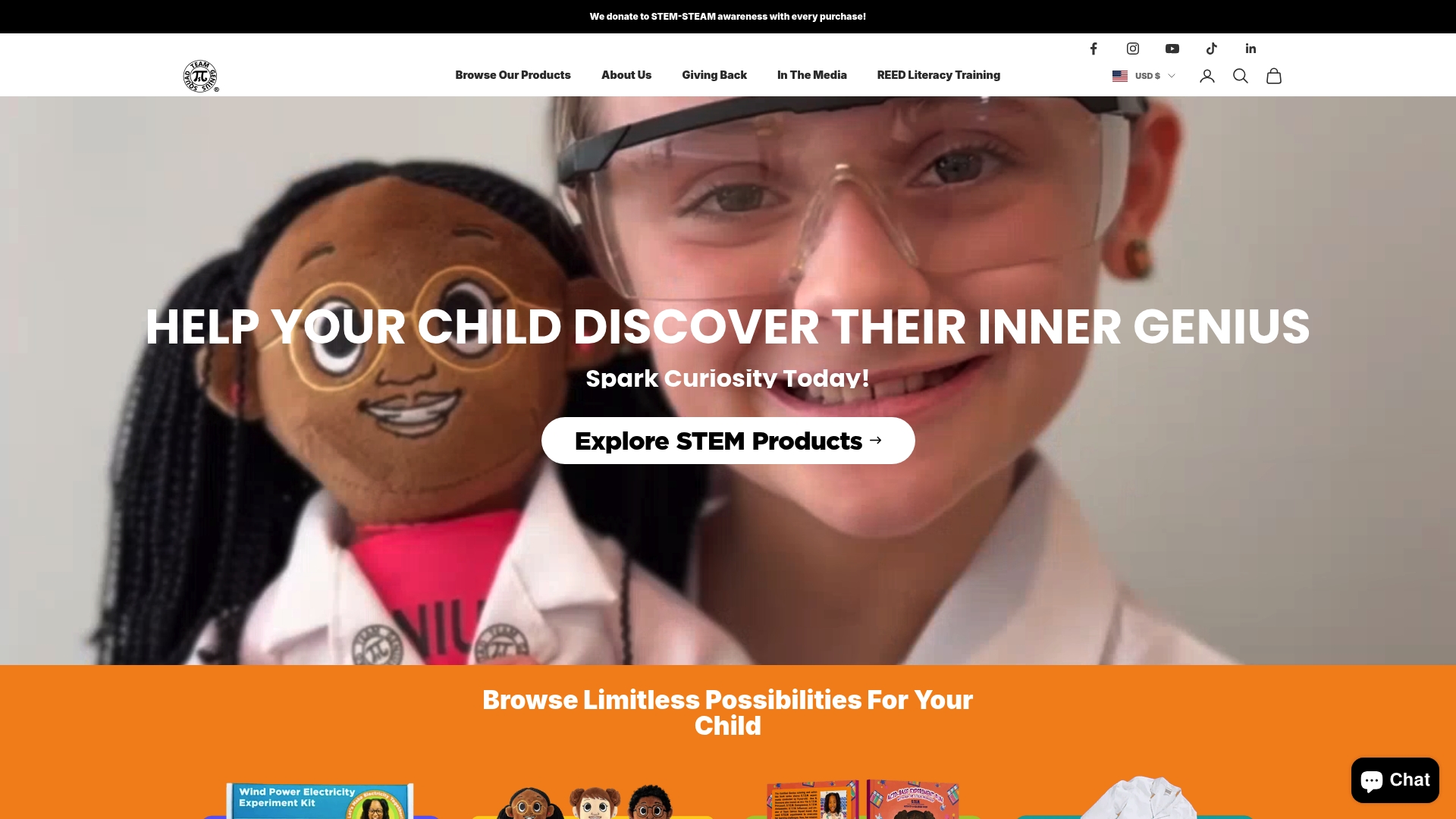
Writing the budget line is simpler than you’d think. List unit cost times the number of kits you need, then add a modest PD line for the time your team spends walking through the accompanying materials. In your narrative, you can honestly write that the kits integrate literacy and reflection alongside the science content, giving your sustainability section real substance instead of a vague promise. A bundle like the STEM-STEAM Electricity Lab Experience works well as a single line item that a small foundation grant can fully cover. Browse our lesson plans to see exactly what you’d cite in your proposal, then bring your shortlisted grant deadline back to your classroom plan and get started on the application this week.
Bookmark These Sources Before Your Next Application
Keep these five sources open in a browser tab folder, not buried in old email threads.
- Grants for searching and applying to federal opportunities and setting deadline alerts.
- NSF’s Robert Noyce program page for federal teacher-development funding and solicitation details.
- Society for Science STEM Research Grants for teacher-level research funding up to $5,000 and application templates.
- Toshiba America Foundation for project-based classroom grants and current windows and exclusions.
- Burroughs Wellcome Fund PRISM for hands-on science and math project funding with PD allowances.
For help drafting measurable outcomes in your narrative, the SMART goals framework offers a straightforward template reviewers recognize immediately.
Sources
- STEM Research Grants | Society for Science
- Robert Noyce Teacher Scholarship Program | NSF
- K-5 STEM Grant SFY27 RFA | Nevada Office of Science, Innovation and Technology

Leave a comment
This site is protected by hCaptcha and the hCaptcha Privacy Policy and Terms of Service apply.