

The History of Ice Cream: 2,500 Years of Frozen Delight
The history of ice cream is defined by a 2,500-year arc of human ingenuity, cultural exchange, and scientific discovery that transformed a Persian luxury into a global staple. Long before electric freezers or commercial dairy plants, ancient engineers built underground ice vaults in desert heat. Chemists unlocked the physics of freezing with salt and saltpeter. Entrepreneurs turned a royal treat into an everyday pleasure. This story connects ancient Persia to 19th-century Baltimore, and it touches every culture in between. Understanding it makes every scoop taste a little more remarkable.
What is the history of ice cream, and where did it begin?
The origin of ice cream traces directly to ancient Persia, where engineers solved one of the ancient world’s hardest problems: keeping ice cold in the desert. Persian yakhchal technology enabled year-round ice storage starting around 550 BCE. These beehive-shaped stone structures used thick insulated walls, underground chambers, and nighttime evaporative cooling to preserve ice harvested from nearby mountains. That engineering feat made frozen treats possible centuries before anyone thought to add cream or sugar.
Early frozen desserts across the Middle East and Asia were far more varied than most people realize. Persian cooks mixed stored ice with fruit syrups, rosewater, and vermicelli noodles to create faloudeh, one of the world’s oldest frozen desserts still eaten today. Arab traders carried these techniques westward after the 7th-century conquest of Persia, spreading sharbat (the ancestor of sherbet and sorbet) across North Africa and into Spain. Meanwhile, the Chinese Tang Dynasty produced frozen milk-curd desserts by packing dairy mixtures in snow, a method documented as early as the 7th century CE.
The Middle East also contributed something Western ice cream never developed on its own: texture through natural stabilizers. Middle Eastern ice creams like booza and bastani use salep (a flour made from orchid tubers) and mastic (a tree resin) to create a stretchy, chewy consistency. That texture is not a modern food science trick. It is an ancient technique refined over centuries of culinary tradition.
- Faloudeh: A Persian frozen dessert of vermicelli noodles in a semi-frozen rosewater syrup, dating back over 2,000 years
- Sharbat: A sweetened fruit and flower water drink served chilled, the direct ancestor of sorbet and sherbet
- Booza: A Middle Eastern ice cream made with salep and mastic, known for its elastic, stretchy texture
- Tang Dynasty frozen desserts: Milk-based mixtures packed in snow or ice, an early precursor to dairy ice cream
Pro Tip: If you want to taste ice cream history firsthand, seek out booza at a Middle Eastern grocery or specialty shop. Its stretchy texture is unlike anything in the Western frozen dessert tradition, and it connects you directly to a 1,000-year-old recipe.
How did science change the way frozen desserts were made?
The leap from storing natural ice to creating cold on demand required chemistry. In 1558, the Italian scholar Giambattista della Porta published Magia Naturalis, which included instructions for chilling liquids using potassium nitrate (saltpeter) dissolved in water surrounding a vessel. This was the first documented method for achieving temperatures below the natural freezing point of water. It meant cooks no longer needed a mountain or a winter harvest to make something cold.
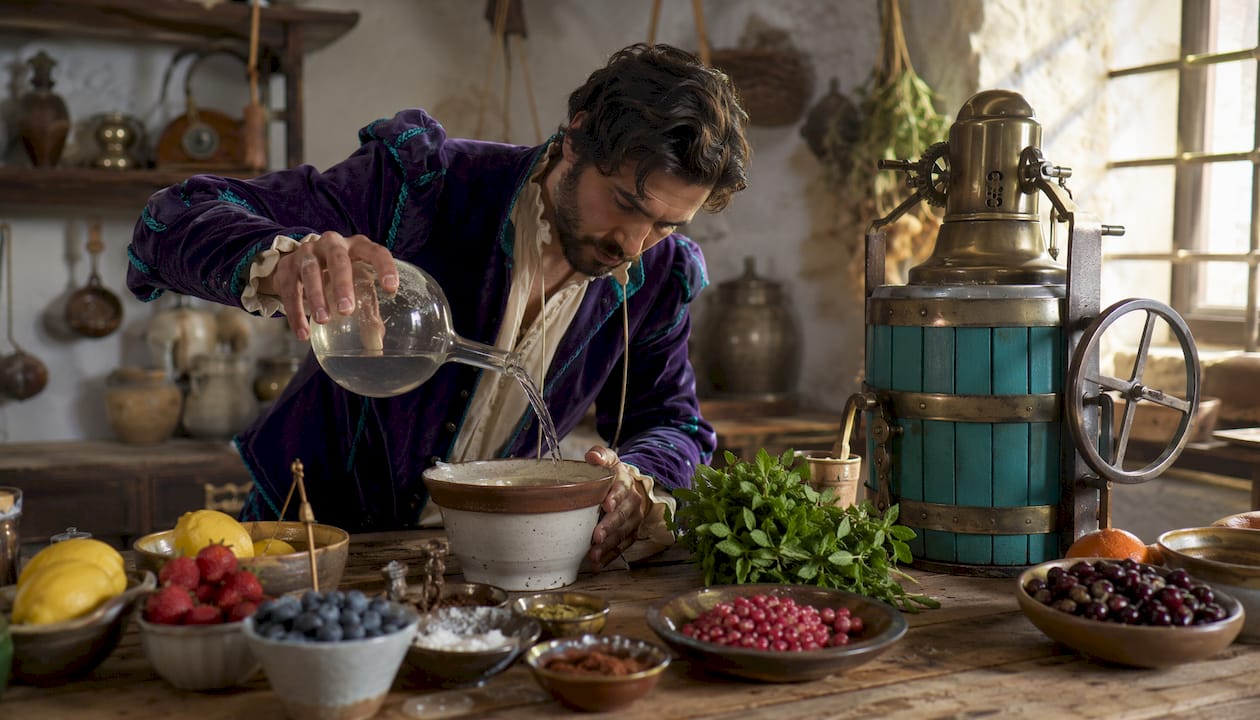
The next breakthrough came from an even simpler ingredient: table salt. Scientists and cooks discovered that mixing salt with ice draws heat out of the surrounding environment, dropping the temperature of the mixture well below 32°F. Salt-ice mixtures gave makers precise control over the freezing process for the first time. Instead of relying on bulk ice stored in a vault, a cook could now freeze a small batch of cream in a metal pot surrounded by salted ice. That shift from storage to production on demand changed everything.
Here is how the science of freezing evolved across three key stages:
- Natural ice storage (550 BCE onward): Yakhchal structures and mountain ice harvesting provided raw cold. Frozen desserts depended entirely on geography and season.
- Chemical chilling (1558): Della Porta’s saltpeter method introduced the concept of endothermic reactions for cooling. Temperature control became a scientific pursuit, not just a logistical one.
- Salt-ice freezing (17th century): Mixing salt with ice lowered the freezing point reliably and cheaply. This made small-batch, on-demand frozen dessert production possible for the first time.
Sugar also played a critical role that most histories overlook. Adding sugar to a cream mixture lowers its freezing point, which keeps the final product soft and scoopable rather than rock solid. Early recipe writers who figured this out were applying food science intuitively, long before food science existed as a discipline. The interplay between salt, ice, sugar, and fat is the same chemistry that governs every batch of ice cream made today.
Who wrote the first ice cream recipes in Europe?
The European chapter of the story of ice cream is a friendly rivalry between Italy and France. Early modern ice cream recipes appeared almost simultaneously in both countries during the 1690s, each tied to noble households seeking to impress aristocratic guests. The Italian steward Alberto Latini published a recipe for a milk-based frozen cream in 1694. The French confectioner Nicolas Audiger documented his own frozen cream preparations around the same period. Both men were working in elite kitchens, and both were building on the salt-ice freezing science that had spread across Europe in the previous century.
The two traditions differed in meaningful ways that still show up in modern frozen desserts.
| Feature | Italian tradition (Latini) | French tradition (Audiger) |
|---|---|---|
| Base ingredient | Milk and cream | Cream and egg yolks |
| Texture goal | Lighter, less dense | Richer, custard-like |
| Modern descendant | Gelato | French-style ice cream |
| Serving temperature | Slightly warmer, softer | Colder, firmer |
The Italian approach prioritized a lighter texture with less fat and more milk, which is why gelato today is denser in flavor but softer in body than American ice cream. The French approach leaned into egg yolks for richness, creating the custard base that defines French-style ice cream. Both traditions spread through European aristocratic culture before eventually reaching the general public.
Pro Tip: The next time you order gelato versus American ice cream, you are choosing between two 17th-century culinary philosophies. Gelato follows Latini’s lighter milk base; American ice cream follows the French custard tradition that crossed the Atlantic with European immigrants.
How did ice cream become a commercial product?
The industrialization of ice cream through the ages happened in three decisive moves, each building on the last. The first came from an American inventor named Nancy Johnson, who patented the hand-cranked ice cream freezer in 1843. Her design used a rotating paddle inside a salt-ice-chilled container to churn cream into a smooth, aerated frozen dessert. The basic mechanical principle she established is still used in home ice cream makers today.
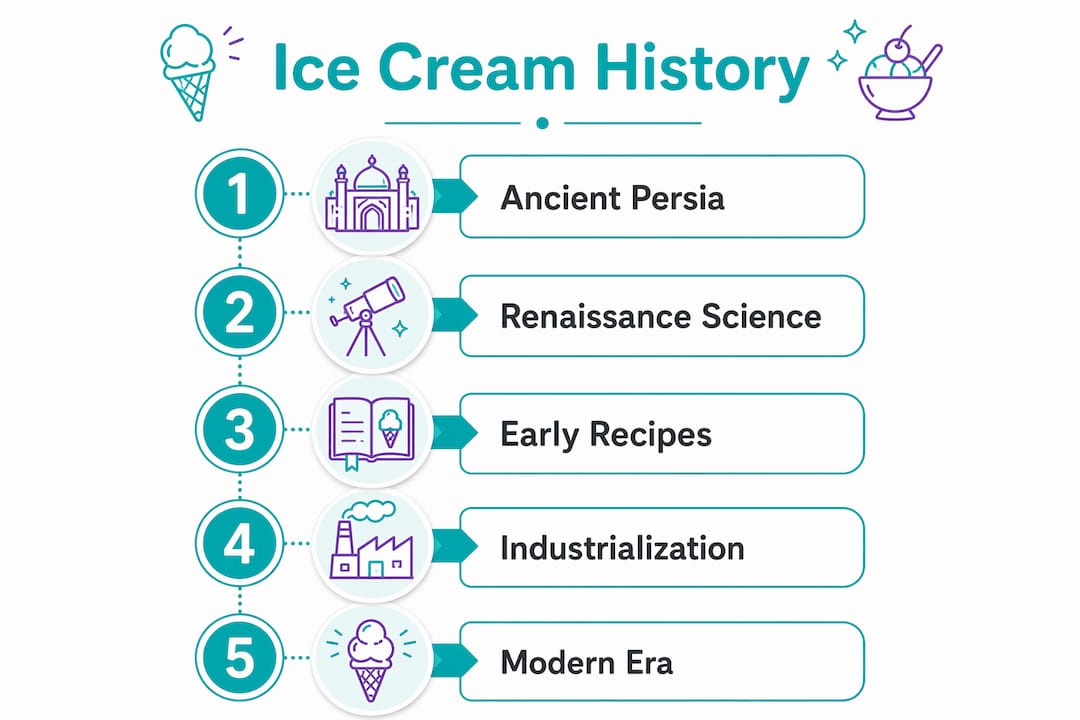
The second move came from a Baltimore dairy farmer named Jacob Fussell. Fussell had a surplus of cream and a business problem to solve. In 1851, he founded the first large-scale commercial ice cream plant in the United States, using Johnson’s churning method at industrial volume. That transition from artisanal to industrial production dropped prices and made ice cream accessible to people who were not wealthy. Ice cream parlors and soda fountains spread rapidly across American cities in the decades that followed.
The third move was purely mechanical. In 1926, Clarence Vogt invented the continuous process freezer, a machine that froze ice cream in a continuous flow rather than in individual batches. That invention made modern factory-scale production possible and gave manufacturers consistent texture across millions of units. The ice cream bar, the ice cream sandwich, and the novelty pop all became viable products because of Vogt’s machine.
- 1843: Nancy Johnson’s hand-cranked freezer patent establishes the mechanical churning method
- 1851: Jacob Fussell opens the first commercial plant in Baltimore, industrializing production
- 1790: George Washington spent $200 on ice cream equipment, signaling early American enthusiasm for the dessert
- 1926: Clarence Vogt’s continuous process freezer enables factory-scale consistency
- Late 19th century: Ice cream parlors and soda fountains become fixtures of American social life
The American enthusiasm for ice cream was not just commercial. It was cultural. George Washington’s $200 investment in ice cream equipment in 1790 tells you something important: even before industrialization, ice cream carried social status and genuine personal pleasure. That combination of aspiration and enjoyment is exactly what drove its commercial explosion a century later.
Key Takeaways
The history of ice cream proves that great food innovations almost always begin with a solved engineering problem, not a recipe.
| Point | Details |
|---|---|
| Ancient Persian origins | Yakhchal ice storage technology from 550 BCE made frozen desserts possible in desert climates. |
| Middle Eastern flavor science | Stabilizers like salep and mastic created stretchy textures centuries before modern food science existed. |
| Chemistry unlocked production | Salt-ice mixtures in the 17th century enabled on-demand freezing, replacing dependence on stored natural ice. |
| European recipes shaped modern ice cream | Latini’s Italian method led to gelato; Audiger’s French custard base became the foundation of American ice cream. |
| Industrialization made it universal | Johnson’s 1843 freezer patent and Fussell’s 1851 plant transformed ice cream from a luxury into an everyday food. |
What ice cream’s long history reveals about human curiosity
What strikes me most about the ice cream cultural history is how consistently it rewards the curious mind. Every major leap in this story came from someone asking a question that seemed impractical at the time. Persian engineers asked how to keep ice cold in a desert. Della Porta asked whether chemistry could replace geography for cooling. Nancy Johnson asked whether a hand-cranked machine could do what a skilled confectioner did by hand. Every answer changed the world’s relationship with frozen desserts.
The continuity between ancient and modern methods is genuinely surprising. The salt-ice principle that della Porta documented in 1558 is the same principle a child uses when making ice cream in a bag at home today. The salep stabilizer that Middle Eastern cooks used a thousand years ago is now being studied by food scientists looking for natural alternatives to synthetic gums. Ancient solutions keep proving their worth.
What I find most exciting is the educational potential packed into this single food. The history of frozen desserts covers physics (endothermic reactions), chemistry (freezing point depression), engineering (yakhchal design, continuous freezers), cultural history (Persian, Arab, Chinese, Italian, French, American), and entrepreneurship (Fussell’s business model). That is a full STEAM curriculum hiding inside a scoop of ice cream. The best learning always works this way: a familiar object opens a door to a much larger world. Helping young learners see that connection is one of the most powerful things an educator or parent can do.
— Tita
Teamgeniussquad turns food science history into hands-on discovery
The same curiosity that drove ancient Persian engineers and 17th-century chemists lives in every child who wonders, “Why does salt make ice colder?” Teamgeniussquad builds on that natural wonder with hands-on STEAM experiment kits designed for children ages 5–13. Each kit uses the E³ Method (Engage, Encourage, Empower) to guide kids from curiosity to confident discovery, screen-free and at their own pace.

The milk-based science experiment kit connects food science directly to the chemistry behind ice cream’s evolution, making abstract concepts tangible and memorable. Teamgeniussquad kits are available through the Whole Foods Launch collection, putting real STEAM discovery within reach for families everywhere. Every kit is a chance for a child to think like the scientists and inventors who shaped the foods we love.
FAQ
How old is the history of ice cream?
The history of ice cream spans over 2,500 years, tracing back to Persian yakhchal ice storage technology around 550 BCE. Early frozen desserts like faloudeh and sharbat predate modern dairy-based ice cream by more than a millennium.
Who invented ice cream first?
No single person invented ice cream. Persian engineers created the ice storage technology that made frozen desserts possible, while Chinese Tang Dynasty cooks developed early milk-based frozen treats, and 17th-century Italian and French confectioners wrote the first modern ice cream recipes.
What is the oldest frozen dessert still eaten today?
Faloudeh, a Persian frozen dessert made with vermicelli noodles in rosewater syrup, is one of the oldest frozen desserts still consumed today, with roots stretching back over 2,000 years.
How did ice cream become affordable for everyone?
Jacob Fussell’s 1851 commercial plant in Baltimore industrialized production and lowered prices significantly. Clarence Vogt’s 1926 continuous process freezer then made factory-scale consistency possible, enabling the mass-market ice cream industry.
What makes Middle Eastern ice cream different from Western ice cream?
Middle Eastern ice creams like booza use natural stabilizers such as salep and mastic to create a stretchy, elastic texture. Western churned ice creams rely on fat, air, and sugar for texture, producing a softer, creamier result without the characteristic chew.



Leave a comment
This site is protected by hCaptcha and the hCaptcha Privacy Policy and Terms of Service apply.