Star life cycle guide: Hands-on STEAM for kids
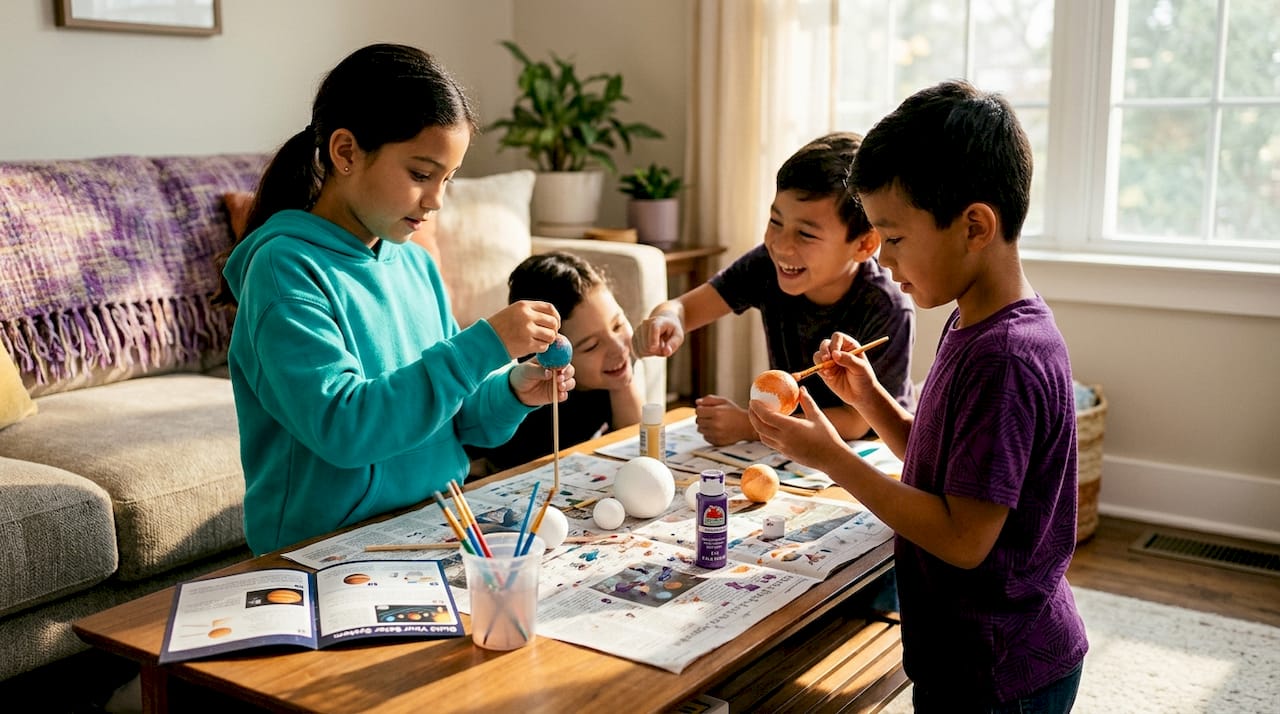
Most people assume every star ends its life the same way, fading out or collapsing into a black hole. That single-path thinking is one of the most common misconceptions in science education, and it quietly limits how curious young learners get to be. NASA confirms that a star’s life cycle branches into different endings based on mass, not all stars become black holes. This guide is designed to help parents and educators turn that fascinating truth into hands-on, screen-free STEAM learning that children ages 5 to 13 will actually remember.
Table of Contents
- What drives a star’s life cycle?
- Branching paths: How star mass shapes destiny
- Screen-free and hands-on: Bringing the stars’ story to life
- Why the branching model matters and what most guides miss
- Next steps: Explore more hands-on STEM with Team Genius Squad
- Frequently asked questions
Key Takeaways
| Point | Details |
|---|---|
| Mass shapes destiny | A star’s mass decides if it becomes a white dwarf, neutron star, or black hole. |
| Stars have branching paths | Stars don’t all follow one path—models should reflect this for better understanding. |
| Balance powers stars | A star’s stability relies on a balance between gravity and nuclear fusion inside. |
| Hands-on learning works | Screen-free games and models make even complex science memorable and fun for kids. |
| Patience with time scales | Stellar life cycles happen over millions or billions of years, but activities can help kids grasp these epic scales. |
What drives a star’s life cycle?
Let’s begin by understanding what’s really happening inside a star and how those forces shape its entire life cycle.
Every star is locked in a constant tug of war. Gravity pulls inward, trying to collapse the star, while the pressure created by nuclear fusion in the core pushes outward. When these two forces balance perfectly, scientists call it hydrostatic equilibrium. For kids, picture two teams in a rope pull where neither side wins. That steady standoff is what keeps a star stable for billions of years.
“A star’s life cycle is driven by the balance between gravity and outward pressure from nuclear reactions in the core.” — NASA
This stable period is called the main sequence, and it is the longest stage in a star’s life. Our own Sun has been in this phase for about 4.6 billion years and has roughly the same amount of time left. When the hydrogen fuel in the core starts running low, that balance breaks, and the star’s story takes a dramatic turn.
The key detail that changes everything is mass. A star’s mass, meaning how much material it contains, is the single biggest factor in deciding what happens next. Think of it like choosing a path in a storybook adventure: a lower-mass star and a higher-mass star start from similar beginnings but end up in completely different places.
Pro Tip: Use a simple kitchen scale and two bags of flour to show kids how mass works. Let them feel the difference between a “sun-like star” and a “massive star” before you even open a book.
You can also explore energy and light concepts hands-on with a solar energy kit that makes the invisible forces of the universe feel real and touchable for young learners.
Branching paths: How star mass shapes destiny
With these forces understood, let’s see why two stars born together might finish their journeys in wildly different ways.
A practical classroom approach is to present the lifecycle as a branching model: the star’s mass largely determines which stages it goes through and its overall lifespan. This is far more accurate than the old “one path fits all” story, and it is also far more exciting for children because it mirrors the logic of a choose-your-own-adventure book.
Here is a simple comparison to share with kids:
| Feature | Sun-like star | Massive star |
|---|---|---|
| Mass | Less than 8 times the Sun | More than 8 times the Sun |
| Main sequence lifespan | Billions of years | Millions of years |
| Red giant phase | Yes | Yes (supergiant) |
| Final stage | White dwarf | Neutron star or black hole |
| Explosion? | No | Yes (supernova) |
A few key facts that will spark great classroom conversations:
- The vast majority of stars in our galaxy, including the Sun, will end as white dwarfs.
- Massive stars burn through their fuel far faster because they run hotter and brighter.
- The branching point happens after the main sequence, not at birth.
- A star 20 times the mass of the Sun may live only a few million years compared to the Sun’s 10 billion year lifespan.
A fun way to make this visual is with a DIY lamp kit where kids explore how energy output changes with different setups, a direct parallel to how a star’s brightness and mass connect.
Sun-like stars: Calm endings after a fiery life
Let’s follow the life of a star like our Sun, step by step, to show exactly what happens at each stage.
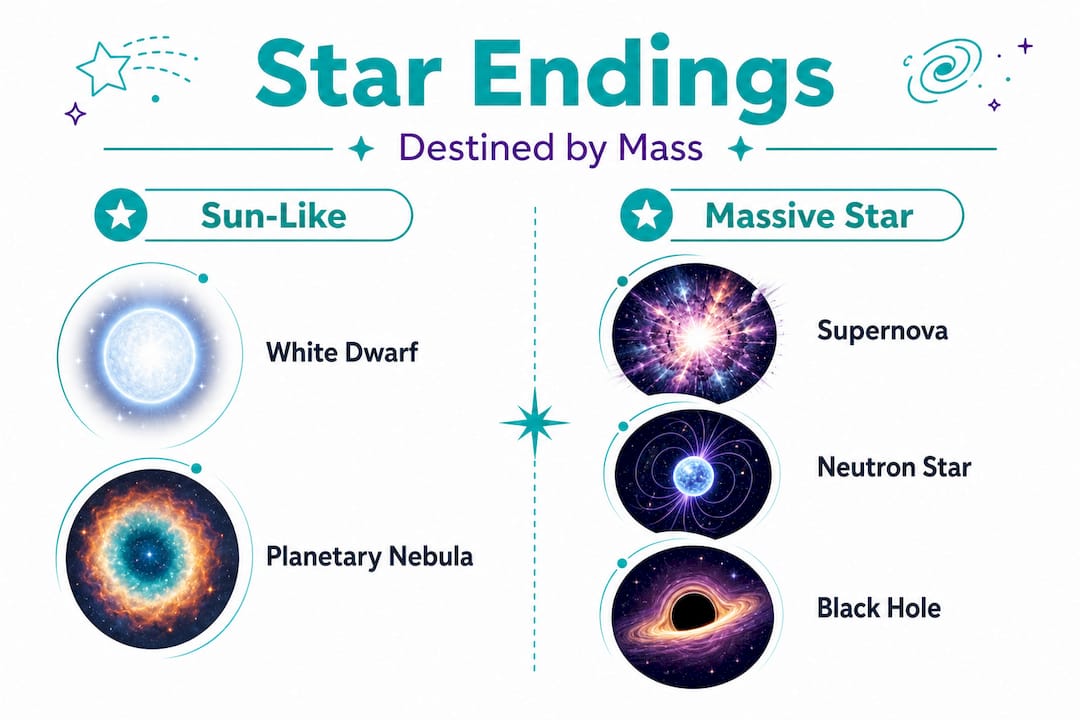
For sun-like stars, the main-sequence phase ends when the core runs out of hydrogen fuel. The star then expands into a red giant, sheds its outer layers to form a planetary nebula, and leaves behind a white dwarf. Each of those stages offers a rich opportunity for storytelling and physical modeling with children.
Here are the four key stages to walk through with your child or class:
- Main sequence: The star burns hydrogen steadily. It is stable, bright, and balanced. This is the longest stage and the one we are living through right now with our Sun.
- Red giant: When hydrogen runs out, the core contracts and heats up while the outer layers expand enormously. The Sun will one day grow large enough to swallow Mercury and Venus.
- Planetary nebula: The outer layers are gently pushed away into space, creating beautiful glowing shells of gas. These are some of the most colorful objects in the universe.
- White dwarf: What remains is a small, dense, hot core that slowly cools over billions of years. It no longer fuses atoms but glows from stored heat.
“The Sun will eventually become a red giant, shed its outer layers into a planetary nebula, and cool into a white dwarf, a journey that takes billions of years but can be acted out in minutes.” — NASA Imagine the Universe
Pro Tip: Have kids act out each stage physically. One child crouches small (main sequence), then stretches arms wide (red giant), then spins and releases a scarf (planetary nebula), then curls into a small ball again (white dwarf). Movement makes abstract timelines stick.
Pair this activity with a STEM book bundle that reinforces the vocabulary and story arc through reading and reflection, supporting both visual learners and those who thrive with narrative.
Massive stars: Powerful endings and cosmic fireworks
But what about the giants among stars? Their final acts are truly explosive, so let’s compare those endings side by side.
Massive stars go through additional, less efficient nuclear burning stages after leaving the main sequence, fusing heavier and heavier elements until reactions can no longer generate enough heat to support the star against gravity. The result is a catastrophic collapse followed by a supernova, one of the most energetic events in the universe.
Here is a quick reference table for ages 8 and up:
| Stage | What happens | Kid-friendly description |
|---|---|---|
| Main sequence | Fusing hydrogen | Steady campfire |
| Red supergiant | Core contracts, outer layers expand | Campfire grows into a bonfire |
| Supernova | Massive explosion | Bonfire explodes like fireworks |
| Neutron star | Ultra-dense core remains | A city-sized ball of pure energy |
| Black hole | Gravity so strong light cannot escape | A cosmic vacuum that swallows everything |
Key points to share with young learners:
- A supernova can briefly outshine an entire galaxy of hundreds of billions of stars.
- Neutron stars are so dense that a teaspoon of their material would weigh about a billion tons.
- Black holes form only from the most massive stars, not from average ones like our Sun.
- The heavy elements created inside massive stars, including iron and gold, are scattered by supernovas and become part of planets and living things.
Exploring atomic structure and molecular bonds with light-up molecule balls gives kids a tactile sense of how matter is built, which connects beautifully to the idea that stars forge the atoms that make up everything around us.
Screen-free and hands-on: Bringing the stars’ story to life
You don’t need screens or expensive telescopes to spark wonder. Here’s how you can bring these cosmic stories to the kitchen table or classroom floor.
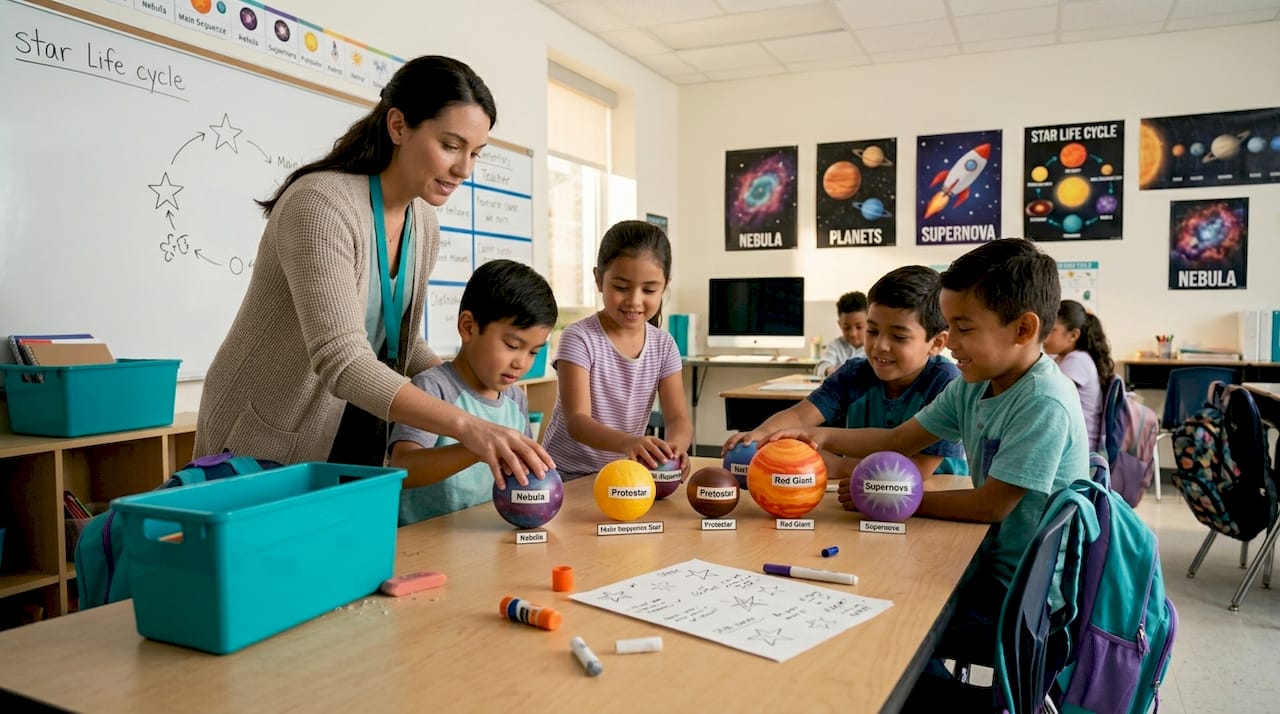
NASA’s kinesthetic activity for the life cycle of a large star is a wonderful model for screen-free, movement-based learning. Children literally become the star, acting out each stage with their bodies and props. This approach works especially well for kinesthetic learners and children who find sitting still during lessons challenging.
Here are practical, screen-free ideas you can try today:
- Sequencing cards: Print or draw images of each star stage and have kids arrange them in the correct order, then explain their reasoning aloud.
- Star journals: After each activity, children write or draw what they observed and what they think comes next, building both science vocabulary and literacy skills.
- Clay modeling: Use different colored clay to build a star at each stage, from a compact main-sequence ball to an expanded red giant to a tiny white dwarf remnant.
- Scale walks: Use a measuring tape or chalk line outside to show how billions of years compare to a human lifetime. Ten steps equals one billion years, so the Sun’s life is a 100-step walk.
- Storytelling circles: Each child takes a role in the star’s life and narrates their stage, building confidence through public speaking and creative expression.
Pro Tip: You do not need to be an astronomer to lead these activities. Your job is to ask great questions: “What do you think happens next? Why does the star get bigger before it gets smaller? What would you name this stage?” Curiosity is the real teacher here.
Check out these interactive classroom ideas for more inspiration on making science tactile and memorable. And if you want to add a glowing, visual element to your space exploration activities, a glow-in-the-dark kit can turn any room into a mini cosmos after lights-out.
Why the branching model matters and what most guides miss
Now that you know the steps and how to teach them, here’s why the way we present the star’s life journey can completely change the outcome for young learners.
Most teaching guides present the star life cycle as a single, linear sequence. A star is born, it burns, it dies. That simplicity feels tidy, but it quietly teaches children that science is a fixed story with one answer. Presenting the lifecycle as a branching model rather than one universal path is essential to avoid oversimplification for ages 5 to 13, and the difference in engagement is remarkable.
When children see that a star’s ending depends on choices shaped by its nature, something shifts. They start asking “what if” questions. They want to know what happens to stars even bigger than the ones they just learned about. That is exactly the kind of curiosity that builds real scientific thinking, not just test-ready facts.
At Team Genius Squad, we believe that confidence comes from discovery, not from passively receiving information. A child who physically acts out a supernova, draws a planetary nebula, and debates with a classmate about what makes a neutron star different from a black hole is building a mental model that no worksheet can replicate. Our STEM books and puzzles are designed with this same philosophy, giving children tools to explore, question, and arrive at their own understanding.
The branching model also honors different kinds of learners. A child who struggles with reading can still sequence cards correctly. A child who finds writing hard can still act out the red giant phase with their whole body. When we teach science through multiple pathways, we create space for every child to succeed, and that success is where genuine confidence begins.
Next steps: Explore more hands-on STEM with Team Genius Squad
Ready for more? Here’s how Team Genius Squad makes teaching and exploring the cosmos even more fun and accessible for kids.
At Team Genius Squad, every resource is built around our E³ Method: Engage, Encourage, Empower. Whether your child is just discovering what a star is or is ready to debate the difference between a neutron star and a black hole, we have screen-free tools designed to meet them exactly where they are.

Explore our full collection of experiment kits to find hands-on activities that connect directly to the science concepts in this guide. Our electricity lab bundle is a fantastic next step for children ready to explore energy and forces at a deeper level. And if your young scientist loved learning about solar energy and light, the solar energy kit brings those concepts to life with real, working experiments. Every kit is designed to help children see themselves as innovators, creators, and future problem-solvers.
Frequently asked questions
What is the main factor that decides how a star will end its life?
A star’s mass is the main factor that determines whether it becomes a white dwarf, neutron star, or black hole, as mass determines which stages a star goes through and its overall lifespan.
How long does the star life cycle take from beginning to end?
The full life cycle of a star can last millions to billions of years depending on its mass, since stellar evolution unfolds across enormous timescales that dwarf human history.
Are there hands-on activities for teaching star life cycles to kids?
Yes, you can use physical models, sequencing cards, and kinesthetic activities to teach these concepts away from screens, including a NASA kinesthetic activity specifically designed for modeling a large star’s life cycle.
Do all stars become black holes?
No, only the most massive stars can become black holes, while sun-like stars finish their lives as white dwarfs after shedding their outer layers.
Why do stars get bigger and then shrink during their lifetime?
Stars expand when their core fuel runs low and later shrink after shedding outer layers or collapsing under gravity, because the main sequence ends after hydrogen runs out, causing the outer layers to expand into a red giant before the star sheds them to form a planetary nebula.



Leave a comment
This site is protected by hCaptcha and the hCaptcha Privacy Policy and Terms of Service apply.