Article: STEM Puzzles: Benefits for Kids Ages 5 to 13
STEM Puzzles: Benefits for Kids Ages 5 to 13
STEM puzzles help children practice spatial reasoning, patience, and flexible problem-solving, and the best ones do it while children feel capable and proud of their work. The research is strongest for early spatial skills and more cautious about long-term outcomes, so this guide separates what is well supported from what is hopeful. You will also find practical ways to guide puzzle time without handing over the answers.
TL;DR
- Puzzle play is linked to stronger spatial skills in young children, and spatial skills are tied to later success in math and STEM fields.
- Puzzles give children a safe place to fail, adjust, and try again, which builds persistence and confidence.
- Many studies are correlational, so no one can promise that a puzzle causes a career outcome. Treat puzzles as one good habit, not a cure-all.
- Adults help most by following the child’s lead, asking questions, and choosing puzzles that are challenging but not overwhelming.
- A STEM puzzle works best when it connects to a story, a role, or a real-world question, not only to a picture on a box.
Table of Contents
- What makes a puzzle a STEM puzzle?
- Benefit 1: Stronger spatial reasoning
- Benefit 2: A bridge to math and later STEM learning
- Benefit 3: Persistence, patience, and a healthy relationship with mistakes
- Benefit 4: Flexible thinking and focus
- What the research does not prove
- Benefit 5: Learning to solve problems together
- How adults can help without giving the answer
- Choosing a puzzle by age
- Our perspective: puzzles are a doorway to identity
- Bring STEM puzzles into your home or classroom
- FAQ
- Sources
What makes a puzzle a STEM puzzle?
Any puzzle asks a child to look at parts, imagine the whole, and test ideas. A STEM puzzle leans into that on purpose. It might show scientists, engineers, or inventors at work, ask the child to read or write about what they discover, or connect to a hands-on experiment afterward.
Is a simple jigsaw already a STEM activity? Researchers at the OECD describe puzzle assembly as a spatial activity that can support spatial and STEM skills. So yes, a plain puzzle contributes. A well-designed STEM puzzle adds context, vocabulary, and curiosity on top of that foundation.
For children ages 5 to 13, that context matters. A five-year-old may be thrilled to find the edge pieces. An eleven-year-old wants to know why the picture matters, who the people on the box are, and what they could build themselves.
Benefit 1: Stronger spatial reasoning
Spatial reasoning is the ability to picture shapes, rotate them in your mind, and see how pieces fit together. It sounds narrow, but it shows up everywhere from reading a map to understanding a diagram in a science book.
The OECD notes that puzzle building involves mental rotation, spatial perception, and spatial visualization. Those are exactly the skills teachers hope children bring to geometry and early engineering.
The evidence includes some well-known work:
- In a U.S. study of preschoolers, children who played with puzzles between ages 2 and 4 performed better on a spatial-transformation task at age 4½, and among puzzle players, how often they played predicted how well they did.
- In research reported by the Association for Psychological Science, children ages 4 to 7 who played with puzzles, blocks, and board games more than six times a week had higher block design scores than children who played less often.
Notice the ages. Much of the best data comes from younger children. We do not claim that a 10-year-old will gain exactly the same boost, but the underlying skill keeps mattering as school gets harder.
Benefit 2: A bridge to math and later STEM learning
Why do educators care about spatial skills so much? The U.S. Institute of Education Sciences describes spatial reasoning as critical to student achievement, particularly in early math, and as a gateway skill to persistence in fields such as engineering, chemistry, and geoscience.
A study from the University of Surrey found that teaching spatial skills with physical manipulatives like puzzles and blocks is highly effective at improving mathematics performance. Researchers also report that the ability to mentally transform shapes predicts STEM course taking, degrees, and careers.
For a parent or teacher, the takeaway is practical. A child who struggles with worksheets may still build the very skills that support math by working with pieces they can touch, turn, and test. That is good news for children who learn best by doing, including many who find traditional pages of text or number drills discouraging.
Benefit 3: Persistence, patience, and a healthy relationship with mistakes
Puzzles are one of the gentlest ways to practice being wrong. A piece does not fit, nothing bad happens, and the child tries another. Over dozens of small attempts, that becomes a habit.
The New Zealand Ministry of Education notes that puzzle play supports hand-eye coordination, dexterity, and dispositions such as patience and persistence. NAEYC describes a similar process with building challenges: when children redesign their structures after failure, they build engineering, problem-solving, and critical thinking skills.
This is the heart of why we care about puzzles. Confidence does not come from being told you are smart. It comes from remembering the time you were stuck and got through it.
Benefit 4: Flexible thinking and focus
A recent randomized controlled trial reported that a 10-week puzzle-play intervention for children ages 4 to 5 led to sustained improvements in inhibitory control and cognitive flexibility, still visible at a three-month follow-up. In plain words: holding back the first impulse and switching strategies when the first one fails.
That is a young age group again, but the skills are ones older children use constantly, whether they are working a multi-step science investigation or reorganizing an essay.
A report on puzzle-based learning from the University of Birmingham suggests that puzzles in STEM education encourage students to take personal responsibility, develop modeling skills, and try creative approaches. The same report argues the approach is under-used in STEM teaching, which is an opportunity for classrooms and homes alike.
What the research does not prove
Honest guidance builds trust, so here are the limits.
The National High School Journal of Science points out that many studies on puzzle play are correlational. It remains hard to prove that puzzles themselves cause improvements rather than other factors, such as a household that plays and talks with children more. The same review says more research is needed before anyone can claim a direct link between early puzzle play and long-term outcomes like choosing a STEM career.
So please be wary of any product page, ours included, that promises a puzzle will make a child a scientist. What a puzzle can do is give a child regular, enjoyable practice at skills that matter, and a reason to feel proud. That is a modest claim, and it is a worthwhile one.
Also remember that many of the strongest studies focus on children younger than five. For ages 5 to 13, the sensible reading is that the skills keep mattering, and that puzzles should grow in complexity as the child does.
Benefit 5: Learning to solve problems together
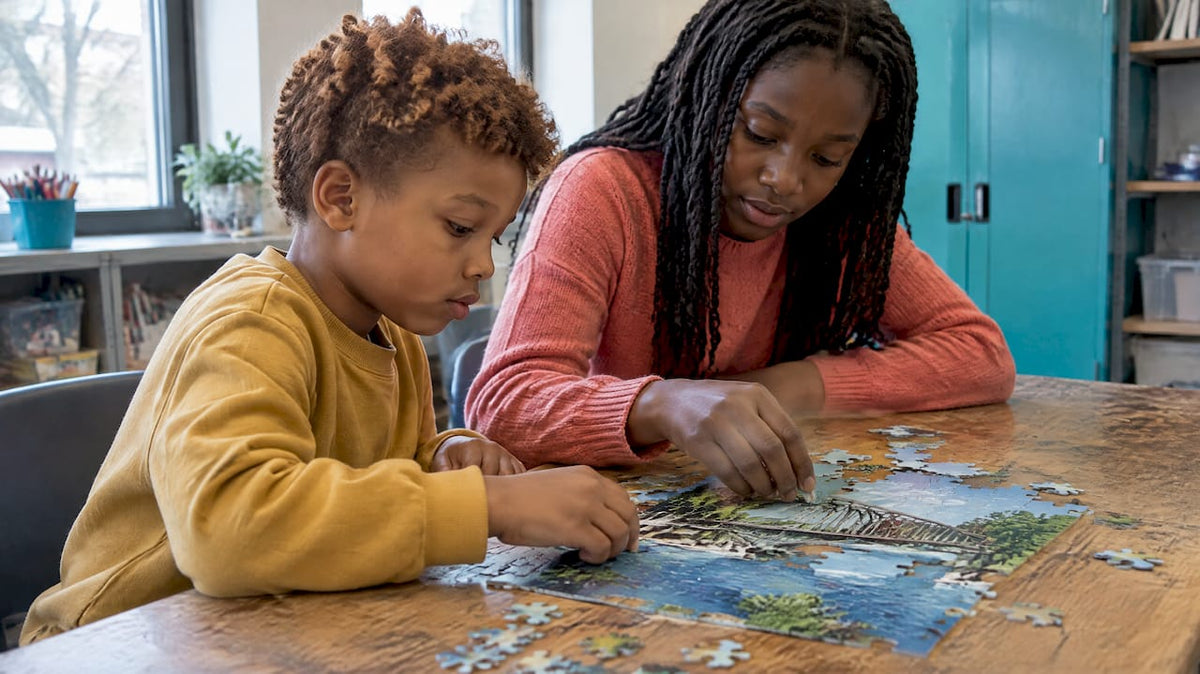
Puzzles are a natural team activity. One child sorts by color, another hunts for corners, a third reads the clue card. Each finds a role, and the group finishes something none of them could finish as quickly alone.
We have not found a single study we would cite on exactly how group puzzle-solving builds social skills in this age range, so we will share what we see rather than claim a statistic. In group settings, the skills children seem to practice are:
- Describing what they see. “The piece with the blue curve” is a surprisingly good exercise in precise language.
- Taking turns and listening. A sibling’s hunch may be right, and children notice when that happens.
- Disagreeing kindly. “Let’s test both” is a skill worth learning at age seven.
- Sharing credit. The finished picture belongs to everyone at the table.
Spatial language matters here too. NAEYC highlights research showing that using words like on top, underneath, and behind during play predicts better performance on spatial problem-solving tasks at age 4½. Children working together naturally use those words aloud.
And puzzles are not only jigsaws. Tactics puzzles in chess, for example, also build pattern recognition, although chess puzzles help beginners most when paired with real play. Variety keeps children curious.
How adults can help without giving the answer
The hardest part of puzzle time for adults is staying quiet. The urge to point at the right piece is strong, and it quietly tells a child that someone else will solve it.
The New Zealand Ministry of Education suggests adults follow a child’s lead, allow them to work at their own pace, and offer prompts and questions that encourage critical thinking. NAEYC adds that adults should let children test their own hypotheses, even when they fail, because that is part of learning resilience and scientific inquiry.
Try questions like these:
- “What do you notice about the edges of this piece?”
- “What could you try if that doesn’t fit?”
- “Where do you think this part of the picture goes, and why?”
- “What would you change if you started over?”
The OECD, drawing on Vygotsky’s zone of proximal development, suggests children learn new spatial skills best when puzzles are challenging but not overwhelming, with the right support. If a child is frustrated for several minutes with no progress, step in with a smaller hint or a simpler section, not the solution.
Choosing a puzzle by age
These are our practical rules of thumb, not research findings. Every child is different, and the right puzzle is the one that stretches them a little.
| Age range | What to look for | What to ask |
|---|---|---|
| 5 to 7 | Larger pieces, bold images, a clear theme, short sessions | “Which part do you want to start with?” |
| 8 to 10 | More pieces, themes that tell a story, room to read and discuss | “What do you think the scientist on the box is working on?” |
| 11 to 13 | Complex images, multi-step challenges, links to real careers | “How would you design something that solves this problem?” |
For classrooms and counseling spaces, a puzzle left out on a table is a low-pressure way to let children warm up, talk sideways, and work at their own pace. Children who find direct conversation hard sometimes open up when their hands are busy.
If you want to take the idea off the table and into the room, our post on unplugged engineering challenges offers screen-free activities that teach iteration. For a building-block approach, see our LEGO STEM challenges by age.
Our perspective: puzzles are a doorway to identity
We started Team Genius Squad from a real family journey with dyslexia and dysgraphia. We watched how a child who struggles with pages of text can light up when the learning moves to their hands. That experience shapes how we think about puzzles.
A puzzle is not only a skills drill for us. It is a chance for a child to say, “I figured that out.” Our E³ Method, Engage, Encourage, Empower, follows that arc: a child is drawn in by something tangible, supported through the tricky middle, and then sees what they accomplished. The finished picture is nice, but the belief that comes with it is the real prize.

That is why our puzzles feature role models and STEM careers, and why we pair them with reading, writing, and reflection. When a child sees scientists and creators on the box and then completes the picture, they step a little closer to seeing themselves in that role. Our founder story, inspired by young STEM entrepreneur Ava N. Simmons, is built on the same idea: different minds can build the future.
We also believe in telling parents the truth about the evidence. Puzzles will not guarantee a result. They will give your child repeated, joyful practice at thinking, trying, and trying again.
— Tita
Bring STEM puzzles into your home or classroom
If you would like puzzles that connect to careers, stories, and confidence-building play, explore our STEM and STEAM puzzle collection. You can also start with the S.T.E.M. Genius Puzzle or the STEM Puzzle Club House, which shows diverse STEM careers in action.
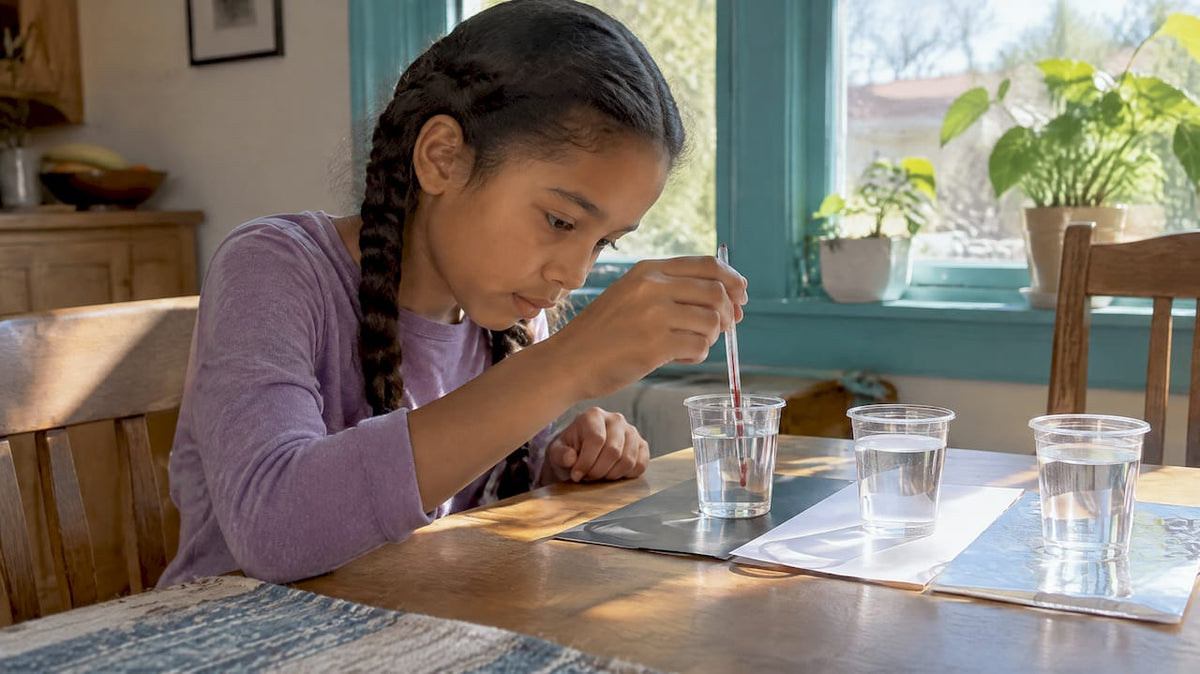
When a child finishes the puzzle and wants to keep going, our experiment kits turn curiosity into real, screen-free experiments, and our books and puzzles pair nicely for reading time. For a live experience, children can meet Ava through a 30-minute Zoom 1-on-1 interactive STEM experiment priced at $50, listed on our shop page.
FAQ
Are puzzles good for children’s brains?
Research links puzzle play to better spatial skills in young children. In one U.S. study, children who played with puzzles between ages 2 and 4 performed better on a spatial task at age 4½, and more frequent play predicted stronger results. Because many studies are correlational, it is fair to say puzzles are associated with these benefits rather than proven to cause them.
Are puzzles a STEM activity?
Yes, they can be. Puzzle assembly is a spatial activity that can support spatial and STEM skills. A STEM-themed puzzle adds careers, vocabulary, and story, which helps older children connect the activity to real-world work.
How can I help my child without solving the puzzle for them?
Follow their lead and let them set the pace. Ask open questions such as “What could you try next?” instead of pointing to a piece. If frustration builds, offer a smaller hint or a simpler section so the challenge stays within reach.
Do puzzles help children with learning differences?
Hands-on work can give children who find traditional text-heavy tasks difficult another way to show what they know. We built our kits from our own family’s experience with dyslexia and dysgraphia, but every child is different. If you have concerns about a specific learning difference, talk with your child’s teacher, school counselor, or pediatrician about what support fits.
Will puzzles make my child choose a STEM career?
No one can promise that. Researchers note that more study is needed before a direct link between early puzzle play and STEM careers can be established. What puzzles can do is build useful skills and confidence along the way.
Sources
- Early Puzzle Play: A predictor of preschoolers’ spatial transformation skill
- Playing With Puzzles and Blocks Could Build Children’s Spatial Skills
- Shapes, blocks, puzzles and origami: From spatial play to learning (OECD)
- The satisfaction of puzzles (New Zealand Ministry of Education)
- Puzzle-Based Learning (University of Birmingham report)
- Using Blocks to Develop 21st Century Skills (NAEYC)
- Rocking and Rolling. Building New Skills: Block Construction (NAEYC)
- Validity Evidence on the Spatial Ability Assessment for STEM (Institute of Education Sciences)
- Spatial training with blocks and puzzles (University of Surrey)
- Puzzle play improves math skills (ScienceDaily)
- The effect of child-appropriate play with various types of puzzles (PubMed)
- The Link Between Early Childhood Puzzle Play and the Development of Spatial Skills (NHSJS)
- Chess puzzles help beginners, and the limits

Leave a comment
This site is protected by hCaptcha and the hCaptcha Privacy Policy and Terms of Service apply.